


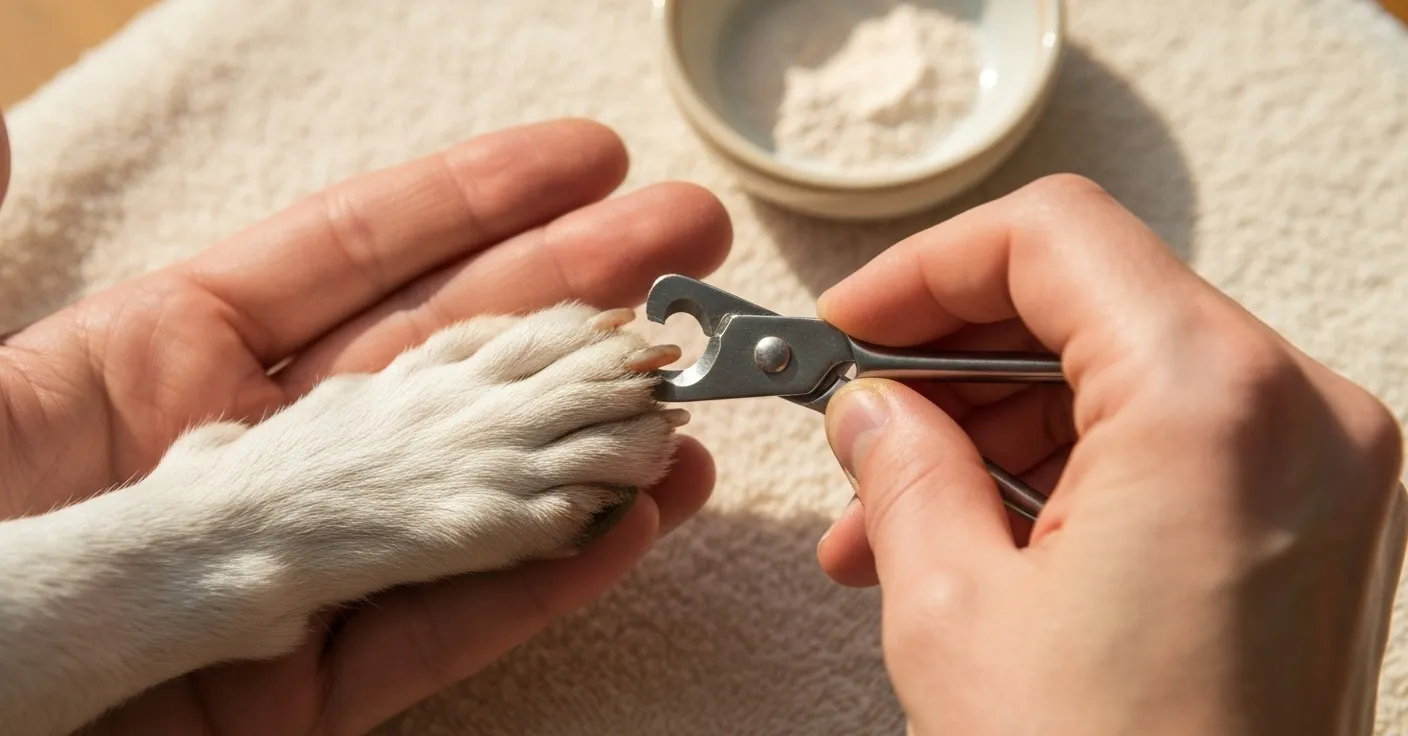
The first time a client of mine successfully trimmed her dog’s nails at home, she texted me a picture of a single, tiny crescent of clipped nail sitting on a paper towel. The dog was an eight-year-old Cavalier King Charles named Pip who had spent his entire life screaming through clinic trims and had, on two occasions, drawn blood from groomers with a back-leg kick. Pip’s owner had been paying ninety dollars a month for sedation-assisted grooming because nobody, including me, had been able to clip a single nail on him while awake. That one crescent on the paper towel had taken six weeks of work — paw touches, treat pairings, a slow introduction to the sound of a clipper opening and closing near his foot, and finally one nail. Six weeks for one nail. By month three, she was doing all four paws in a single sitting without a flinch.
I tell new clients this story because home nail trimming is two skills layered together, and most people think it’s only one. The mechanical skill — knowing where to cut, what tools to use, how to handle a styptic emergency — can be taught in an afternoon. The behavioral skill — getting a dog to consent to having its paws handled without bracing or pulling away — is the part that takes weeks. Skip the second skill and you’ll spend the rest of your dog’s life wrestling. Build it patiently and you’ll have a calm two-minute job every two weeks for the next decade.
Why nail length actually matters
A dog’s nails aren’t ornamental. They’re load-bearing structures that contact the ground at every step, and when they grow too long, the entire kinetic chain reorganizes around them. Overgrown nails push the toes upward off the floor, shifting weight back onto the carpal and tarsal joints (wrists and ankles), changing the angle at which the long bones of the leg meet the ground. Over months and years, that altered angle generates compensatory strain through the shoulders, elbows, hips, and lower back (Yam et al., 2015).
Bockstahler and colleagues used force-plate gait analysis in dogs with chronically overgrown nails and documented measurable asymmetries in weight distribution and stride length compared to dogs maintained on regular nail trims (Bockstahler et al., 2007). The effect compounds with age. A senior dog with overgrown nails is dealing with arthritis stacked on top of altered loading, which is part of why nail length tends to show up as one variable in conversations about how much exercise senior dogs actually need — joint pain that looks like “slowing down” sometimes turns out to be partly mechanical and partly avoidable.
The rule most veterinary behaviorists use: if you can hear the nails clicking on a hard floor when your dog walks, they’re too long. A properly trimmed nail clears the floor when the dog is standing relaxed on a flat surface. You shouldn’t hear them at all.
Inside the nail: keratin, dentin, and the quick
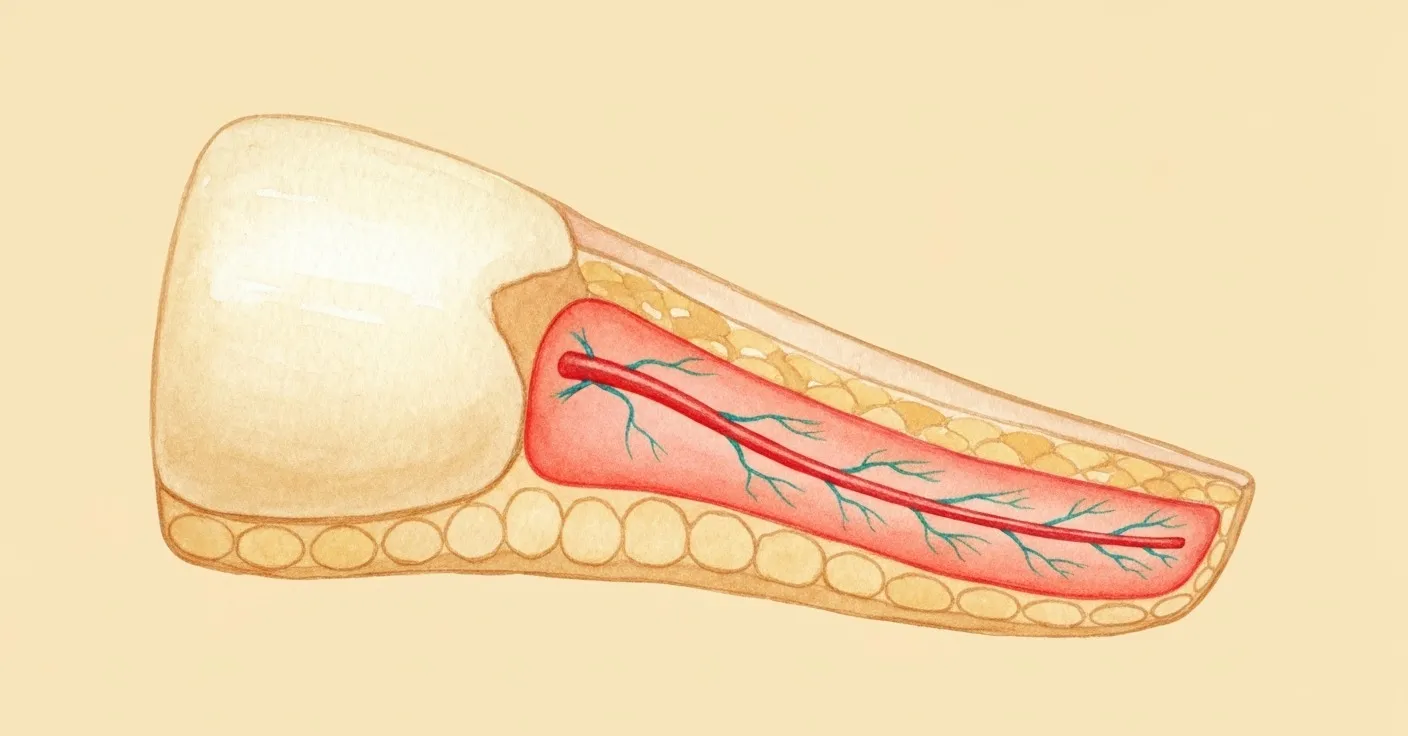
Understanding what you’re cutting matters more than picking the right tool. A dog’s nail is structured in three concentric layers. The outer shell is keratin — the same hardened protein that makes up hair and the surface of footpads. Underneath that is a layer of dentin, similar in composition to the dentin in teeth, which provides the bulk of the nail’s structure. At the very center, running about two-thirds of the way down the nail from the toe joint, is the quick: a soft pink core that contains a single artery, a vein, and a bundle of sensory nerves (Köster et al., 2011).
Cutting into the quick produces two things at once: sharp pain, because the nerves are highly innervated, and a steady drip of blood that is usually less serious than it looks but very persistent. A dog whose quick has been hit even once tends to flinch at the next trim — and at the trim after that, and the trim a year later. The behavioral cost of one bad cut can outlast the wound by years. This is why the entire skill set is built around staying well shy of the quick rather than getting as close to it as possible.
The other useful thing to know about the quick: it recedes as the nail gets shorter. If you maintain a dog’s nails at a length where the quick is forced backward by regular trims, the quick will retract over time, giving you more usable nail to work with. Conversely, when nails are allowed to overgrow for months, the quick grows longer along with them. Bringing those nails back to a healthy length is a multi-month project of small, frequent trims, not a single dramatic cut.
The tools: guillotine, scissor, grinder
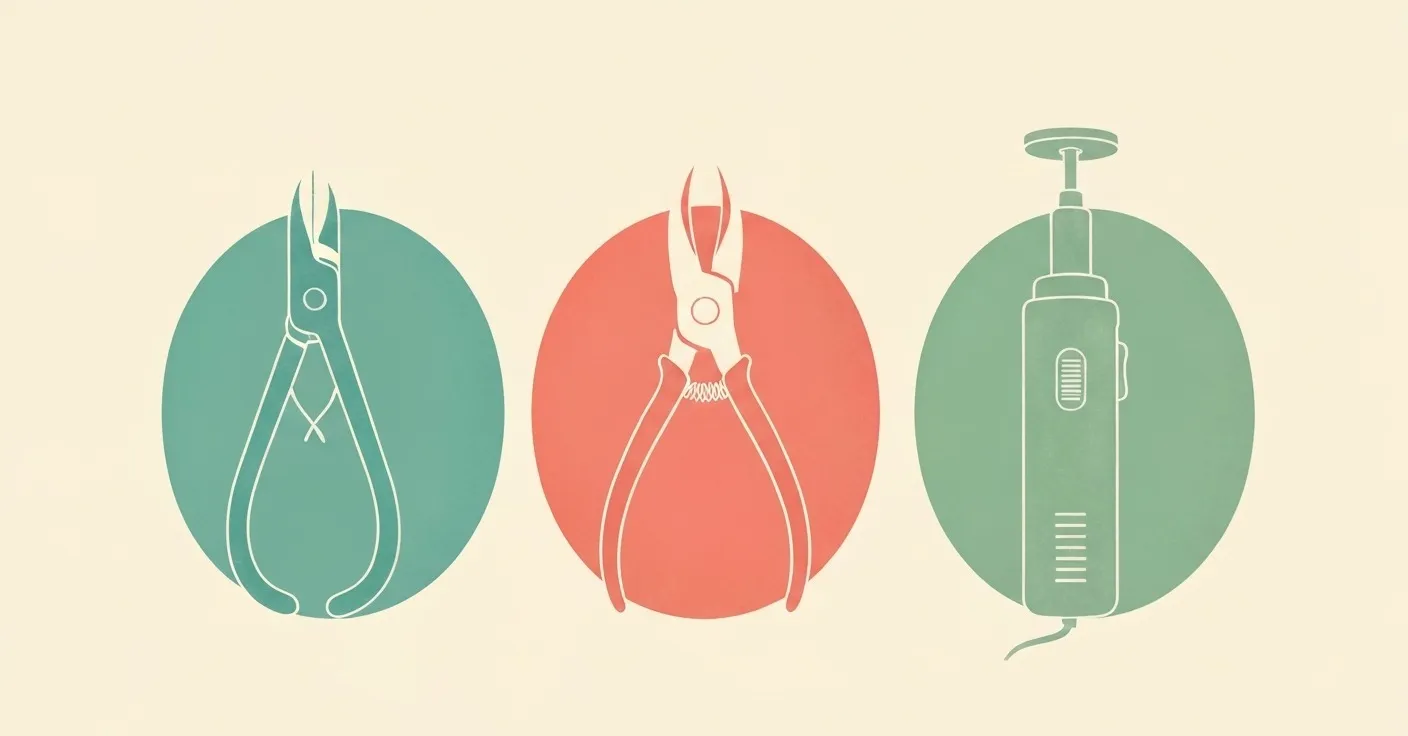
There are three categories of nail tools that work, and each one has a profile that suits some dogs better than others.
Guillotine clippers have a hole the nail slides into and a blade that drops through it when you squeeze the handle. They’re inexpensive, easy to position on small and medium nails, and give a clean cut when the blade is sharp. The trade-off: the blade dulls reasonably quickly, and on thick nails (large breeds, older nails with thicker keratin), a dull guillotine blade compresses the nail before slicing through, which can hurt even without hitting the quick. They’re a reasonable first tool for a small dog or a puppy.
Scissor-style or plier-style clippers are the most versatile option, and the ones most veterinary technicians use day-to-day. They have two cutting blades that close around the nail like pruning shears. The handles give better leverage on thick nails, the blades hold their edge longer, and the visual angle is easier — you can see exactly where the blades will close before you commit. For dogs over about 30 pounds, this is usually the right starting tool. Spring-loaded designs with locking handles reduce hand fatigue if you’re trimming several dogs in a row or working with thick senior nails.
Rotary grinders (Dremel-style tools) sand the nail down with a rotating abrasive head rather than cutting it. The blood-draw risk is dramatically lower because you’re removing material in tiny increments and can stop the instant you see the inner layer change color. Two drawbacks: it takes substantially longer per nail, often three to five minutes for a full paw, and the noise and vibration are unfamiliar to most dogs. Habituating a dog to the grinder is a separate desensitization project — letting them hear it run from across the room first, then closer, then touching the off tool to a paw, then the on tool, building up over days or weeks before any actual sanding happens (Mills et al., 2014). For owners willing to invest the time, the grinder is the lowest-stress option once a dog is acclimated, especially for dogs with very dark nails where the visual cues are harder to read.
A note on cheap clippers: a dull or flexing blade is the single biggest cause of cracked nails and pinching during home trims. The hundred-dollar professional clippers and the fifteen-dollar pet-store version often look identical in the box, but the cutting geometry is different, and so is the steel. If you’re going to do this regularly, the better tool pays for itself in a year.
Where to cut: the white-nail and dark-nail cues
Cutting a white or clear nail is the easier case. Hold the paw with the toe gently extended, look at the nail from the side, and locate the pink quick visible inside the keratin shell. The cut goes 2 to 3 millimeters past the visible end of the quick, angled so the cut surface roughly parallels the floor when the dog is standing. The first cut should feel underwhelming. If you can see the underside of a sliced nail starting to look concentric — a small chalky ring with no pink or wet appearance in the center — you’re at the right depth. Past that ring is where the quick lives.
Dark nails are the harder case, and the place most home trimmers either freeze up or cut too far. You can’t see the quick through the pigment, so you can’t aim relative to it directly. The technique that works is the slice approach: take a series of very thin slices off the tip of the nail, 1 millimeter at a time, looking at the cut surface after each one. The first few slices show a uniform chalky white or pale gray cross-section. As you get closer to the quick, a small dark dot — sometimes pink, sometimes gray, sometimes almost black — appears in the center of the cut surface. That dot is the leading edge of the quick. Stop immediately. One more slice past that dot will hit blood.
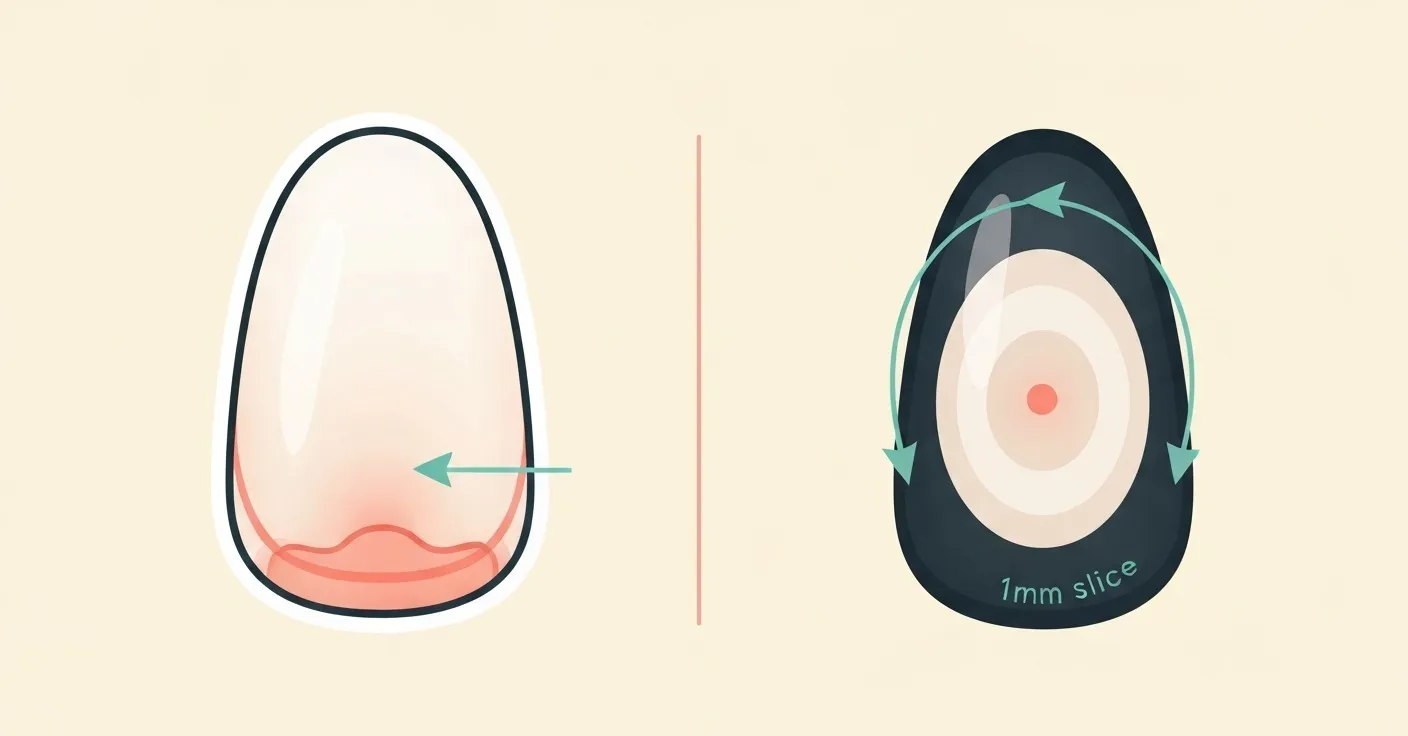
This is the entire reason patience matters more than precision on dark nails. Many small slices give you many chances to stop. One confident large cut gives you no chances.
The dewclaws, when present, often get missed in home trims because they don’t bear weight and grow without abrasion. They can curl back into the pad if neglected, which is painful and prone to infection. Include them every trim.
Handling, positioning, and the behavior layer
Position matters almost as much as cutting technique. Small dogs can usually be trimmed in your lap, belly-up, with the paw extended away from the body. Medium and large dogs are easier standing on a non-slip surface, with you positioned at the dog’s flank and the paw lifted backward toward you (similar to how a farrier picks up a horse’s hoof). Reaching across the front of a dog to grab a paw triggers a defensive flinch in most dogs, even calm ones — coming from the side or behind is less confrontational.
The behavioral protocol that holds up across the research is straightforward and slow:
- Touch and treat. For one to two weeks before any cutting happens, touch each paw briefly during calm moments and pair the touch with a high-value treat. The dog should start to anticipate food when you reach for a foot.
- Tool introduction. Show the clipper or grinder, let the dog sniff it, treat. Open and close the clipper near the dog without contact, treat. If using a grinder, run it for a second near the dog without touching, treat.
- Tool-to-paw, no cutting. Touch the closed clipper to the side of a nail. Treat. Touch the running grinder to a paw pad (not a nail) for half a second. Treat. Build duration over multiple sessions.
- One nail. When the dog is calm through all the prior steps, do one nail. Treat lavishly. End the session.
- Build up. Add one or two nails per session over the next several sessions until you can do a full paw or all four paws in one sitting.
This is the framework Overall describes in detail as part of canine counter-conditioning protocols, and the same general structure shows up in Friedman’s work on positive reinforcement training in veterinary contexts (Overall, 2013; Friedman, 2015). The goal isn’t speed — it’s a dog whose nervous system stops anticipating the nail trim as a threat.
For dogs whose anxiety carries beyond the trim itself into general daily skittishness, a calm baseline routine matters more than any single intervention. Petterm Muscle Gain Soft Chews are formulated around overall daily routine support — useful as part of the broader pattern of consistent feeding, predictable handling, and structured rest that grooming-tolerant dogs tend to share. They’re not a sedative and not a substitute for desensitization work, but a steady daily routine is the soil that behavioral training grows in.
When you hit the quick: stop the bleeding, keep the trust
You will eventually hit a quick. Every experienced groomer has done it; every veterinary technician has done it. The goal isn’t never doing it — the goal is handling it calmly so the dog doesn’t generalize from the moment.
The first-line tool is styptic powder (ferric subsulfate), sold under brand names like Kwik Stop. Press a small pinch directly into the bleeding nail tip and hold gentle pressure for 30 seconds. The powder triggers vasoconstriction and clotting and typically stops the bleed within a minute. If you don’t have styptic powder, plain cornstarch or all-purpose flour works as a backup — less effective, but available in any kitchen. Direct pressure with a clean cloth for two to three minutes will also work in most cases, though it requires patience and a dog willing to hold still.
What matters as much as the powder is your demeanor in the next 60 seconds. Dogs read panic. Keep your voice low and even, keep the handling matter-of-fact, give a treat once the bleeding stops, and end the session there. Pretending nothing happened — neither apologizing repeatedly nor scolding the dog for flinching — is the right register. The pain itself fades within minutes. The behavioral association is what carries forward, and a calm closure to the session keeps that association manageable (Hielm-Björkman et al., 2009).
If a quick bleeds for more than five minutes despite styptic and pressure, or if a nail has cracked deep into the nail bed (a different injury than a normal trim cut), that’s a vet visit rather than a home-managed event. Persistent bleeding can indicate a clotting issue, and a deep crack is prone to infection of the underlying bone.
Puppies and the early-start advantage
Puppies who have their paws handled from 8 to 10 weeks of age, and who experience clippers as a low-stakes, well-fed event before their nails ever need a real trim, grow into adults who tolerate trims as background routine (Davies, 2012). This window matters. Dogs who don’t have positive paw-handling experiences during the socialization period (roughly 3 to 14 weeks) tend to be harder to convert as adults, though not impossible — Pip from the opening anecdote is proof of concept on the slow path.
For new puppies: touch the paws every day during play or rest. Trim or grind off the very tips of the nails weekly even when they barely need it. The point is the routine, not the length removed. A puppy who has been through twenty pleasant trim sessions by six months old has fundamentally different expectations than one who experiences a first trim at a year of age.
Frequently asked questions
How often should I trim my dog’s nails?
Every two to three weeks is the most common cadence for dogs on a maintenance schedule. Dogs that walk extensively on concrete or pavement may need less frequent trims because the surface naturally abrades the nails. Dogs that mostly walk on grass or carpet will need them more often. The audible test — clicking on a hard floor — is a reasonable trigger for “trim today.”
What if my dog’s nails are already very overgrown?
Don’t try to fix it in one session. The quick is now also overgrown, and a single aggressive cut will hit it. The fix is small trims every 5 to 7 days for several months. Each trim encourages the quick to recede by a millimeter or two. Within 8 to 12 weeks, most overgrown nails can be brought back to a healthy length.
My dog screams when I touch his paws — is something wrong?
A dog who has never had a painful paw experience and suddenly reacts that way to touch may have a paw injury — a foxtail, a torn pad, an interdigital cyst, or in older dogs occasionally a soft-tissue tumor. Check between the toes and around the pads in good light. If the reaction is consistent and you can’t find an obvious cause, a vet exam is reasonable. For dogs reacting to paw touch without prior injury, it’s usually a learning history issue rather than a medical one, and the counter-conditioning protocol above is the path forward.
Should I trim the dewclaws?
Yes, every time. Dewclaws don’t contact the ground, don’t wear down naturally, and can curl back into the pad if neglected. Some dogs have rear dewclaws as well as front; check all four legs. Dogs with double rear dewclaws (Great Pyrenees, some other breeds) need particular attention because the extra nails are easy to miss.
Is it normal for my dog to leave the room when I get out the clippers?
Common, but worth addressing. A dog who has learned to leave when clippers appear has built an association between the tool and an unpleasant outcome. Restart the desensitization sequence — clipper visible but unused, paired with high-value food, multiple times a week — until the visual of the clipper stops triggering avoidance. This is usually a two- to four-week project rather than a same-day fix.
Can I use human nail clippers on a small dog?
Technically yes for very young puppies, no for adult dogs. Human clippers are designed for flat human nails and tend to crush a round dog nail rather than slicing it cleanly, which is uncomfortable even when it doesn’t hit the quick. The cheapest pet-specific scissor clipper will cut better than the best human nail clipper.
How long should a nail trim session take?
Three to five minutes for a confident dog and a confident handler, including dewclaws. If a session is consistently running 20 minutes with a struggle in the middle, the issue is rarely the tool or the technique — it’s the behavioral foundation. Slow down, go back to paw-touch-and-treat for a few weeks, then try again.
When to involve a vet or professional groomer
For most healthy adult dogs with normal nail anatomy, home trimming is genuinely manageable once the routine is built. There are situations where delegating is the safer call — and a smaller set of situations where home management of a nail problem turns into a same-day medical issue.
Watch and manage at home if: your dog tolerates handling, your tools cut cleanly, you’ve hit a quick once or twice without lasting behavioral fallout, and the trims are progressing on a regular schedule. A small bleed managed with styptic powder and a calm end to the session is a normal, not catastrophic, event.
Book a vet or experienced groomer if: your dog’s anxiety is severe enough that handling triggers panic, urination, or biting attempts despite weeks of desensitization work; a nail has cracked deep into the nail bed; you suspect an ingrown nail curling into the paw pad; there’s swelling, discharge, or a foul smell around the nail base suggesting infection; or your dog has a clotting disorder or is on anticoagulant medication, in which case even a routine trim can produce prolonged bleeding. Senior dogs with combined arthritis and paw sensitivity sometimes do better with a low-stress groomer or fear-free certified veterinary technician, especially if home sessions are clearly stressful for both sides. Watery, persistent eye changes alongside grooming-related stress in older dogs may be worth a separate look, since the underlying causes covered in the guide to dog eye discharge types sometimes overlap with general handling sensitivity in the senior population.
References
-
Yam, P.S., Penpraze, V., Young, D., Todd, M.S., Cloney, A.D., Houston-Callaghan, K.A., & Reilly, J.J. (2015). “Validity, practical utility and reliability of Actigraph accelerometry for the measurement of habitual physical activity in dogs.” Journal of Small Animal Practice, 56(2), 86–91.
-
Bockstahler, B.A., Skalicky, M., Peham, C., Müller, M., & Lorinson, D. (2007). “Reliability of ground reaction forces measured on a treadmill system in healthy dogs.” The Veterinary Journal, 173(2), 373–378.
-
Köster, L.S., Spencer, S., Hill, K.E., & Marshall, J.C. (2011). “Anatomical and histological observations on the canine digital pad and nail.” Anatomia, Histologia, Embryologia, 40(4), 312–318.
-
Hielm-Björkman, A.K., Kapatkin, A.S., & Rita, H.J. (2009). “Reliability and validity of a visual analogue scale used by owners to measure chronic pain attributable to osteoarthritis in their dogs.” American Journal of Veterinary Research, 70(6), 727–734.
-
Overall, K.L. (2013). Manual of Clinical Behavioral Medicine for Dogs and Cats. St. Louis, MO: Elsevier Mosby.
-
Friedman, S.G. (2015). “What’s wrong with this picture? Effectiveness is not enough.” Journal of Veterinary Behavior: Clinical Applications and Research, 10(4), 358–360.
-
Mills, D.S., Karagiannis, C., & Zulch, H. (2014). “Stress — its effects on health and behavior: a guide for practitioners.” Veterinary Clinics of North America: Small Animal Practice, 44(3), 525–541.
-
Davies, M. (2012). “Geriatric screening in first opinion practice — results from 45 dogs.” Journal of Small Animal Practice, 53(9), 507–513.
-
American Animal Hospital Association (2022). “AAHA Canine Life Stage Guidelines.” Journal of the American Animal Hospital Association, 58(1), 1–24.
-
American Veterinary Medical Association (2020). “Welfare implications of grooming and handling practices in companion animals.” AVMA Animal Welfare Division Literature Review.
-
AKC Canine Health Foundation (2021). “Nail care and lower limb biomechanics in companion dogs.” Educational Series.
Researched and reviewed by the Petterm Editorial Team · Last reviewed May 2026
This article is for educational purposes and is not veterinary medical advice. Petterm products are not intended to diagnose, treat, cure, or prevent any disease. Results may vary. Always consult your veterinarian before introducing a new supplement, especially if your dog has an existing condition, takes medication, is pregnant, or is under 12 weeks old.