



A client emailed me a photo last spring of her three-year-old Labrador, Pippa, standing sideways on a kitchen tile. Pippa looked like a barrel with legs. Her owner, Joanne, swore she was following the feeding chart on the back of the bag exactly. Three and a quarter cups of kibble a day, split into two meals, plus a handful of training treats. By the chart on the bag, that was the recommended amount for a “moderately active 25 kg adult dog.” Pippa was 31 kg and climbing. The chart wasn’t lying, exactly. It was just written for a different dog than the one Joanne actually had at home. We cut Pippa’s daily calories by about 22%, weighed everything on a kitchen scale for two weeks, and rechecked her ribs at the four-week mark. She lost almost a kilogram in that first month without ever looking hungry.
Why the bag chart usually misses
The feeding chart printed on most kibble bags is built around a specific assumed dog: intact, lean, and getting at least an hour of structured exercise daily. That’s the energy profile manufacturers index to, because it’s the population the original calorie-need studies were performed on (NRC, 2006). The problem is that the median pet dog in a North American or European household isn’t that dog. Surveys put the proportion of overweight and obese dogs somewhere between 34% and 59%, depending on the methodology and country (German, 2006; Salt et al., 2017). Most are spayed or neutered. Most don’t run for an hour a day.
Neutering alone reduces a dog’s daily energy needs by roughly 25 to 30%, partly through metabolic shifts and partly through behavioral ones (Jeusette et al., 2004). Stack a sedentary lifestyle on top of that, and the bag chart can overshoot by 20 to 30% for a typical pet dog. That’s not a rounding error. Over a year, an extra 100 calories a day puts about 3 to 4 kg of fat on a medium-sized dog. The math compounds quietly.
What we want instead is a calorie target built from your actual dog’s body weight and lifestyle, then translated back into cups, grams, or cans of whatever food you’re feeding. The translation is the easy part. The calorie target is the part that takes a minute of arithmetic.
Step one: calculate resting energy requirement (RER)
Resting energy requirement, or RER, is the number of calories a dog burns at complete rest just keeping the lights on. It’s the baseline. Every other adjustment scales off this number.
The formula veterinary nutritionists use comes from work compiled in the National Research Council’s Nutrient Requirements of Dogs and Cats (NRC, 2006) and is reproduced in most clinical nutrition textbooks (Hand & Lewis, 2010):
RER (kcal/day) = 70 × body weight (kg)^0.75
The exponent (0.75) matters. Metabolic rate doesn’t scale linearly with body weight, because larger animals have lower surface-area-to-volume ratios and proportionally lower per-kilogram heat loss. A 50 kg dog doesn’t need twice the calories of a 25 kg dog. It needs about 1.7 times as many.
Let’s work two examples.
A 25 kg Labrador. 25^0.75 ≈ 11.18. Multiply by 70: RER ≈ 783 kcal/day.
A 7 kg Dachshund. 7^0.75 ≈ 4.30. Multiply by 70: RER ≈ 301 kcal/day.
If you don’t have a calculator that does fractional exponents handy, there’s a reasonable shortcut for dogs in the 2 to 45 kg range: RER ≈ (30 × body weight in kg) + 70. For our 25 kg Lab, that gives 820, which is within 5% of the real value. Close enough for kitchen math.
Step two: apply the right life-stage multiplier
RER is the resting baseline. Maintenance energy requirement, or MER, is what your dog actually burns once you account for activity, life stage, and reproductive status. MER equals RER multiplied by a factor specific to the dog in front of you.
The factor matrix below is drawn from the NRC consensus and AAFCO life-stage frameworks (NRC, 2006; AAFCO, 2024):
- Neutered adult, low activity (typical pet dog): 1.4 to 1.6 × RER
- Neutered adult, moderate activity (a daily walk, weekend hikes): 1.6 to 1.8 × RER
- Intact adult, active: 1.6 to 2.0 × RER
- Senior dog (over ~7 to 9 years, slowing down): 1.2 to 1.4 × RER
- Weight loss target: 1.0 × RER (sometimes lower under vet supervision)
- Weight gain target: 1.6 to 1.8 × RER of ideal body weight, not current
- Puppy, weaning to 4 months: 3.0 × RER
- Puppy, 4 months to adult size: 2.0 × RER
- Working / sporting dog in heavy training: up to 4.0 to 8.0 × RER for sled dogs and field trial dogs (Hinchcliff et al., 1997)
Back to Pippa, the 31 kg Labrador. Using her target weight of 25 kg, her RER was 783 kcal. As a neutered, mostly sedentary three-year-old, her real MER sat around 1.4 × RER, or roughly 1,100 kcal/day. The bag chart had been delivering her about 1,420 kcal/day for “moderately active.” The 320-calorie daily surplus is most of what built her barrel shape.
Senior dogs deserve their own note. By age seven, a Labrador’s lean body mass starts dropping by roughly 1 to 2% per year unless deliberately countered with diet and movement (Freeman, 2012). Lower lean mass means a lower resting burn, which is why the senior multiplier slides down to 1.2 to 1.4. But this is also where calorie cuts go wrong if they’re done without rechecking body condition. Cut too aggressively, and you accelerate muscle loss instead of fat loss. The companion piece on how much exercise senior dogs actually need goes deeper into pairing calorie targets with appropriate movement for older dogs.
Step three: cross-check with body condition score
A calorie target is a hypothesis. Body condition score (BCS) is how you test it.
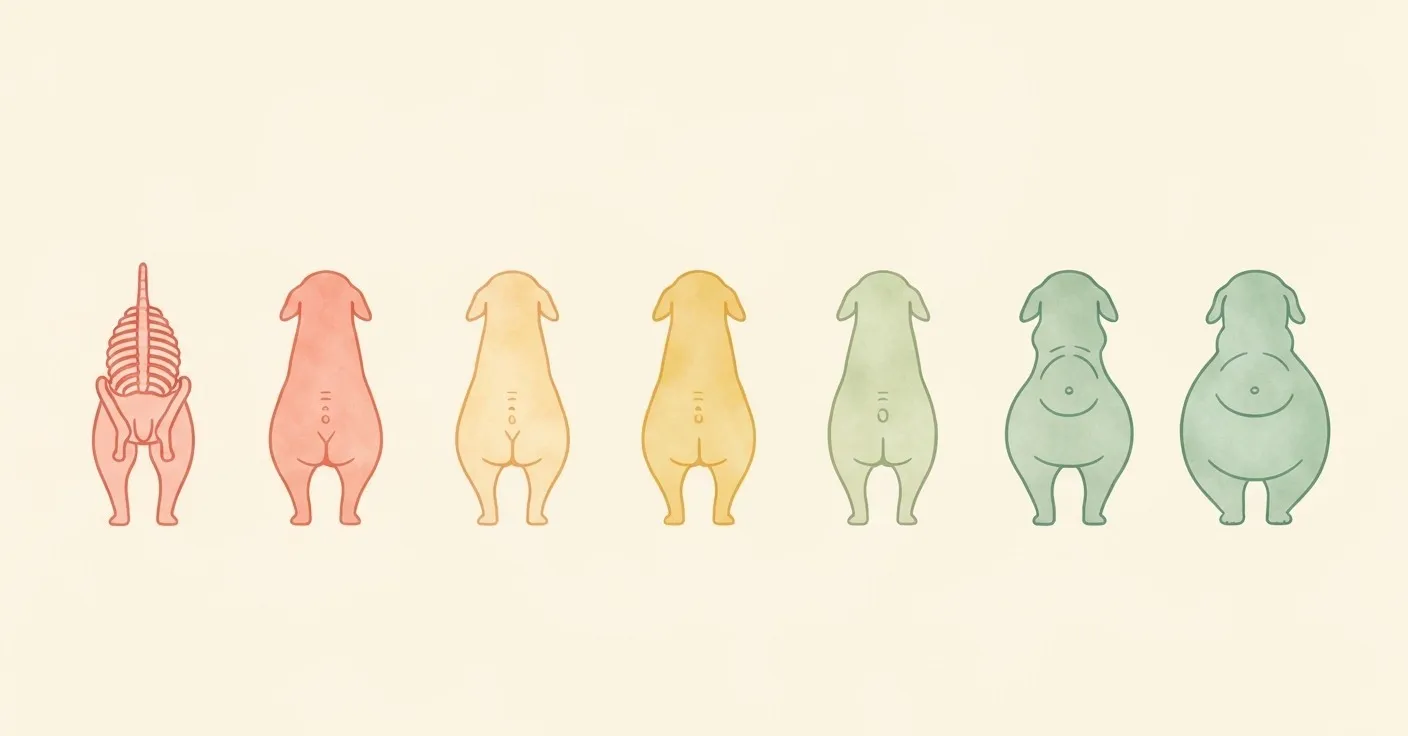
The WSAVA 9-point body condition scoring system, originally validated by Laflamme in 1997 and refined in subsequent veterinary work (Laflamme, 1997; Burkholder, 2000), is the standard most veterinarians use in clinic. The basics:
- BCS 1–3: Underweight. Ribs, spine, and pelvic bones easily visible. Severe loss of muscle.
- BCS 4–5: Ideal. Ribs palpable with light pressure, slight waist visible from above, abdominal tuck from the side.
- BCS 6: Slight excess. Ribs harder to feel through a fat layer. Waist still visible but less obvious.
- BCS 7–9: Overweight to obese. Ribs hard or impossible to feel. No waist. Fat deposits over the lumbar area and tail base.
The rib check is the single most useful at-home test. Run your hands flat along your dog’s ribcage. You should feel ribs with the same pressure it takes to feel the knuckles on the back of your own hand. If you have to press, your dog is carrying excess fat. If they feel like a washboard with no padding, your dog is too lean (Hall et al., 2009).
The adjustment rule of thumb: if your dog’s BCS is one full point above ideal at recheck, reduce daily calories by roughly 10%. One point below ideal, add 10%. Re-check monthly, not weekly. Body composition shifts slowly, and the daily noise from gut contents and hydration is louder than any real change you’d see over a few days.
Step four: translate calories into actual food
Now the math gets useful. Every commercial dog food publishes a metabolizable energy value, usually as kcal per cup or kcal per kilogram, somewhere on the bag or the manufacturer’s website. If it isn’t on the bag, email the company. Reputable manufacturers respond within a few business days.
A typical dry adult maintenance kibble runs 340 to 420 kcal per cup. A “weight management” or “light” formula sits closer to 280 to 320 kcal per cup. A performance or puppy formula often hits 450 to 500 kcal per cup. Wet food varies enormously by water content, but most canned adult diets land between 0.9 and 1.4 kcal per gram, meaning a 400 g can typically supplies 350 to 550 kcal.
Pippa’s daily target was 1,100 kcal. Her food ran 380 kcal per cup. 1,100 ÷ 380 ≈ 2.9 cups daily. That’s significantly less than the 3.25 cups the bag chart had suggested, and it’s why a kitchen scale or properly measured cup matters. A “cup” scooped freehand from a kibble bin can carry 15 to 30% more food than a properly leveled measuring cup (German et al., 2011). For a dog on a calorie budget, that’s the difference between maintaining weight and quietly gaining it.
If you feed a mix of wet and dry, the math is the same. Count the calories in each, total them, and confirm they hit the MER target. For dogs with dental issues, joint considerations, or finicky appetites, wet food at higher caloric density per gram can be a useful tool, since smaller volumes deliver the same energy.
Step five: budget for treats and chews
The 10% rule is one of the most widely cited and least followed guidelines in canine nutrition. The principle is simple: no more than 10% of a dog’s daily caloric intake should come from treats, chews, table scraps, or supplements. The remaining 90% needs to come from a complete and balanced diet, because treats are not nutritionally complete (Linder & Parker, 2016).
For Pippa, 10% of 1,100 kcal is 110 kcal of treat allowance. That sounds generous until you do the audit:
- One medium dental chew: 80 to 120 kcal
- A standard biscuit: 30 to 50 kcal
- A small training treat (pea-sized): 3 to 8 kcal
- A tablespoon of peanut butter: about 90 kcal
- A single small dog chew strip: up to 130 kcal
The dental chew alone often blows the daily treat budget for a medium dog. This is where small training treats earn their keep. A handful of pea-sized rewards across a training session can stay well under 50 kcal, leaving room for a small chew or a piece of fruit later. If you use a daily wellness supplement, that’s also part of the 10%. Petterm Muscle Gain Soft Chews supports daily nutrition for dogs of all sizes, and the soft chew format makes them easy to count toward the treat allowance without over-stacking with biscuits or jerky pieces.
When calorie cuts feel impossible because the dog “always seems hungry,” the treats are usually where the problem actually lives. Pulling them out, weighing them, and adding them up honestly is the most useful single step most owners can take.
Step six: adjust through life-stage transitions
Feeding amounts aren’t static. Three transitions cause the most confusion.
Puppy to adult. Small and medium breeds typically reach adult size between 10 and 12 months. Large and giant breeds keep growing until 18 to 24 months. The transition from puppy formula (around 2 to 3 × RER) to adult maintenance (1.4 to 1.6 × RER) should happen gradually over two to three weeks once growth has clearly plateaued and the dog is at or near adult body weight. Cutting calories too soon stunts growth; cutting them too late starts the lifelong overweight pattern.
Spay or neuter. Resting energy needs drop by 25 to 30% within weeks of the procedure (Jeusette et al., 2004). Many vets recommend a 20 to 25% reduction in daily calories starting the day after surgery, with a four-week recheck. Dogs spayed or neutered young and fed at intact-adult levels are the single most common population of overweight pets in clinic data (Lund et al., 2006).
Entering senior years. Energy needs typically taper by 10 to 20% somewhere between age 7 and 10, depending on breed and individual metabolism (Linder & Mueller, 2014). Some seniors stay surprisingly active and need almost no calorie reduction. Others slow dramatically and need a meaningful cut to avoid weight gain. BCS at three-month intervals is the most reliable signal here. Protein needs do not drop with age — if anything, they rise — which is covered in protein for dogs.
For dogs who’ve fallen below ideal weight, the recovery process is more than calorie addition. Lean mass has to be rebuilt with appropriate protein, exercise, and patience, as discussed in helping underweight dogs gain muscle.
A note on individual variation
The RER formula and MER multipliers are population averages. Individual dogs can vary from the calculated number by ±20% based on genetics, thyroid status, gut microbiome composition, and dozens of other factors that aren’t easy to measure at home (Bermingham et al., 2014). That’s not a flaw of the math. It’s a feature of biology.
This is why the workflow ends with a body condition check, not with the calculation. The calculation gets you to a reasonable starting amount. The two-week recheck and the monthly BCS confirm whether that starting amount was right for your particular dog. If your dog is gaining weight on the calculated MER, their real burn is lower than average and you adjust down. If they’re losing weight, the opposite. The number is a hypothesis. The dog is the proof.
Weigh weekly on the same scale, ideally at the same time of day. Recheck BCS by hand monthly. Adjust by no more than 10% at a time. Repeat until the dog is stable at ideal condition. Most healthy adult dogs settle into a steady-state feeding amount within two to three months of starting this process.
Frequently asked questions
Should I feed once a day or twice?
Twice daily is the most common recommendation for adult dogs and tends to support steadier energy and digestion. Once-daily feeding has gained interest from longevity research in laboratory animals, but data in pet dogs is still thin. Puppies under six months should eat three to four times a day to support growth and avoid hypoglycemia. The total daily calorie target stays the same regardless of how you split it.
How do I know which life-stage multiplier to use?
Start with the most conservative one for your dog’s profile. For a neutered, mostly indoor adult dog, that’s 1.4 × RER. For an intact young adult walking an hour or more daily, try 1.6 × RER. The two-week recheck tells you whether you guessed right. Most owners who calculate honestly find they were overfeeding before, not underfeeding.
What about free-feeding?
Leaving food out all day works for a small minority of dogs who self-regulate well, but most don’t. Free-fed dogs in long-term studies are consistently heavier than meal-fed dogs of the same breed and activity level (Kealy et al., 2002). If you’re trying to land on a precise calorie target, scheduled meals are nearly always easier than ad-lib.
Does kibble or wet food have more calories per gram?
Dry kibble is much more calorie-dense per gram (typically 3.5 to 4.5 kcal/g) because most of the water has been removed. Canned wet food usually runs 0.9 to 1.4 kcal/g. A dog eating wet food gets a larger volume of food for the same calories, which can help with satiety on a weight-loss plan.
My dog acts hungry constantly. Am I underfeeding?
Probably not, if BCS is at 5 or above and weight is stable. Hunger behavior is shaped heavily by routine, learned cues, and breed (Labradors in particular have a documented genetic variant linked to food motivation). Try splitting the same daily amount into more meals, using slow-feeder bowls, or offering a few cucumber slices or green beans as low-calorie volume.
Can I just use an online dog food calculator?
Most online calculators use some version of the same RER + MER formula. They’re fine as a shortcut as long as you understand what they’re doing. The risk is plugging in optimistic numbers (overestimating activity, underestimating treats) and getting a target that’s still too high. The arithmetic is more useful when you do it yourself, because you can adjust the multipliers honestly.
How long should weight loss take?
Healthy weight loss in dogs runs about 1 to 2% of body weight per week (Brooks et al., 2014). For a 31 kg dog targeting 25 kg, that’s roughly four to six months of steady progress. Faster than 2% per week often signals muscle loss alongside fat loss, which isn’t what you want. Slow is sustainable.
When to contact your veterinarian
Calorie adjustment is a reasonable home-managed change for most healthy dogs. It becomes a medical question in specific situations.
Watch and adjust at home if: your dog is otherwise healthy, eating normally, and you’re fine-tuning portion size to support body condition. Recheck weight weekly and BCS monthly. Most calorie corrections work without veterinary input.
Call your vet within 24 to 48 hours if: your dog is gaining or losing weight unexpectedly despite consistent feeding, has had recent blood work that flagged thyroid or metabolic values, shows persistent excessive hunger paired with weight loss, has lost more than 10% of body weight in under three months without a planned diet change, or is on medication that could affect appetite or metabolism (steroids, anticonvulsants, certain heart medications).
Seek same-day veterinary care if: there’s sudden refusal to eat lasting more than 24 hours, marked lethargy, vomiting or diarrhea alongside appetite change, or signs of a medical emergency such as severe abdominal distension, collapse, or rapid breathing. Sudden appetite changes in dogs are rarely about food preference and often signal an underlying medical problem.
References
-
National Research Council (NRC) (2006). Nutrient Requirements of Dogs and Cats. Washington, DC: National Academies Press.
-
Association of American Feed Control Officials (AAFCO) (2024). Official Publication. Champaign, IL: AAFCO.
-
Laflamme, D.P. (1997). “Development and validation of a body condition score system for dogs.” Canine Practice, 22(4), 10–15.
-
Burkholder, W.J. (2000). “Use of body condition scores in clinical assessment of the provision of optimal nutrition.” Journal of the American Veterinary Medical Association, 217(5), 650–654.
-
Hall, J.A., et al. (2009). “Comparison of body condition score, ultrasound, and dual-energy x-ray absorptiometry in evaluating body composition in dogs.” American Journal of Veterinary Research, 70(12), 1494–1500.
-
German, A.J. (2006). “The growing problem of obesity in dogs and cats.” Journal of Nutrition, 136(7), 1940S–1946S.
-
Salt, C., et al. (2017). “Association between life span and body condition in neutered client-owned dogs.” Journal of Veterinary Internal Medicine, 33(1), 89–99.
-
Jeusette, I., et al. (2004). “Effect of ovariectomy and ad libitum feeding on body composition, thyroid status, ghrelin and leptin plasma concentrations in female dogs.” Journal of Animal Physiology and Animal Nutrition, 90(1-2), 12–18.
-
Bermingham, E.N., et al. (2014). “Energy requirements of adult dogs: a meta-analysis.” PLoS ONE, 9(10), e109681.
-
Linder, D.E., & Mueller, M.K. (2014). “Pet obesity management: beyond nutrition.” Veterinary Clinics of North America: Small Animal Practice, 44(4), 789–806.
-
German, A.J., et al. (2011). “A simple, reliable tool for owners to assess the body condition of their dog or cat.” Journal of Nutrition, 136(7), 2031S–2033S.
-
Hand, M.S., & Lewis, L.D. (2010). Small Animal Clinical Nutrition, 5th ed. Topeka, KS: Mark Morris Institute.
-
Kealy, R.D., et al. (2002). “Effects of diet restriction on life span and age-related changes in dogs.” Journal of the American Veterinary Medical Association, 220(9), 1315–1320.
Researched and reviewed by the Petterm Editorial Team · Last reviewed May 2026
This article is for educational purposes and is not veterinary medical advice. Petterm products are not intended to diagnose, treat, cure, or prevent any disease. Results may vary. Always consult your veterinarian before adjusting your dog’s feeding plan, especially if your dog has a diagnosed medical condition, takes medication, is pregnant or lactating, or is a puppy under 12 weeks old.