


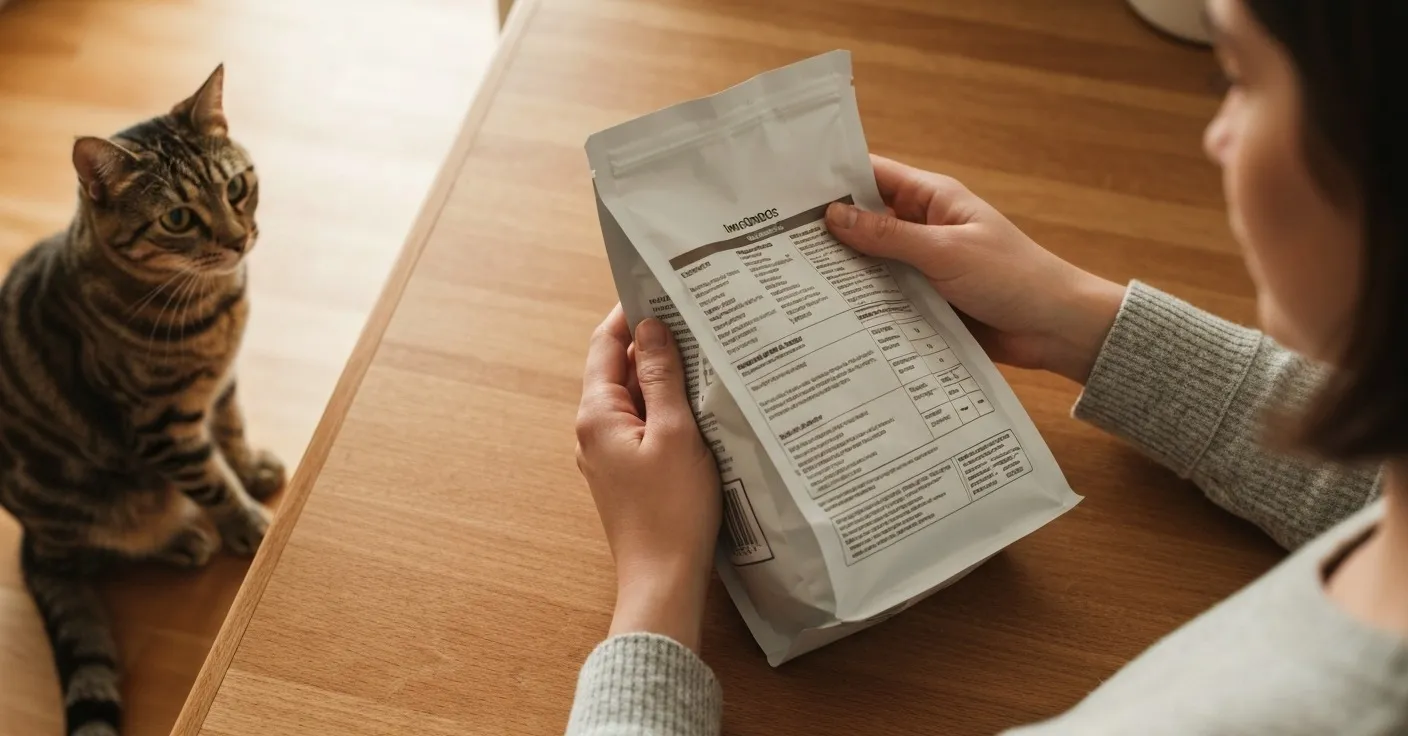
Last spring, I sat across a kitchen counter in Brooklyn with a woman named Priya and her seven-year-old tortoiseshell, Mango. Priya had two bags of cat food in front of her, plus a stack of cans. She’d been switching Mango between them every couple of weeks because each had a problem she couldn’t quite name. The grain-free kibble said “with real salmon” on the front but listed pea protein and potato starch high in the panel. The “natural” can said 10% protein on the back, which sounded laughable next to the 36% on the kibble. Mango, meanwhile, was overweight and occasionally vomited hairballs onto the rug. Priya wanted to know if she was being scammed. She mostly wasn’t. She just hadn’t been taught what the back of the bag is really saying.
What’s on a cat food label, and what each part is for
A pet food label in the U.S. is governed by overlapping rules. The FDA sets the framework, AAFCO publishes the model nutrient profiles and ingredient definitions, and states adopt the AAFCO model with small variations (AAFCO, 2024). What ends up on the bag is a compromise between marketing real estate on the front and required disclosures on the back.
The pieces that matter are the guaranteed analysis, the ingredient list, the AAFCO nutritional adequacy statement, the feeding directions plus calorie content, and the manufacturer’s contact information. The front of the bag is mostly atmosphere. If you spend ten minutes shopping, eight of those minutes should be on the back.

The guaranteed analysis: a small table that hides almost everything
The guaranteed analysis is the densest source of information on the label, and also the most misread. By regulation, it lists protein and fat as minimums and fiber and moisture as maximums. The numbers are reported on an as-fed basis, meaning they include water.
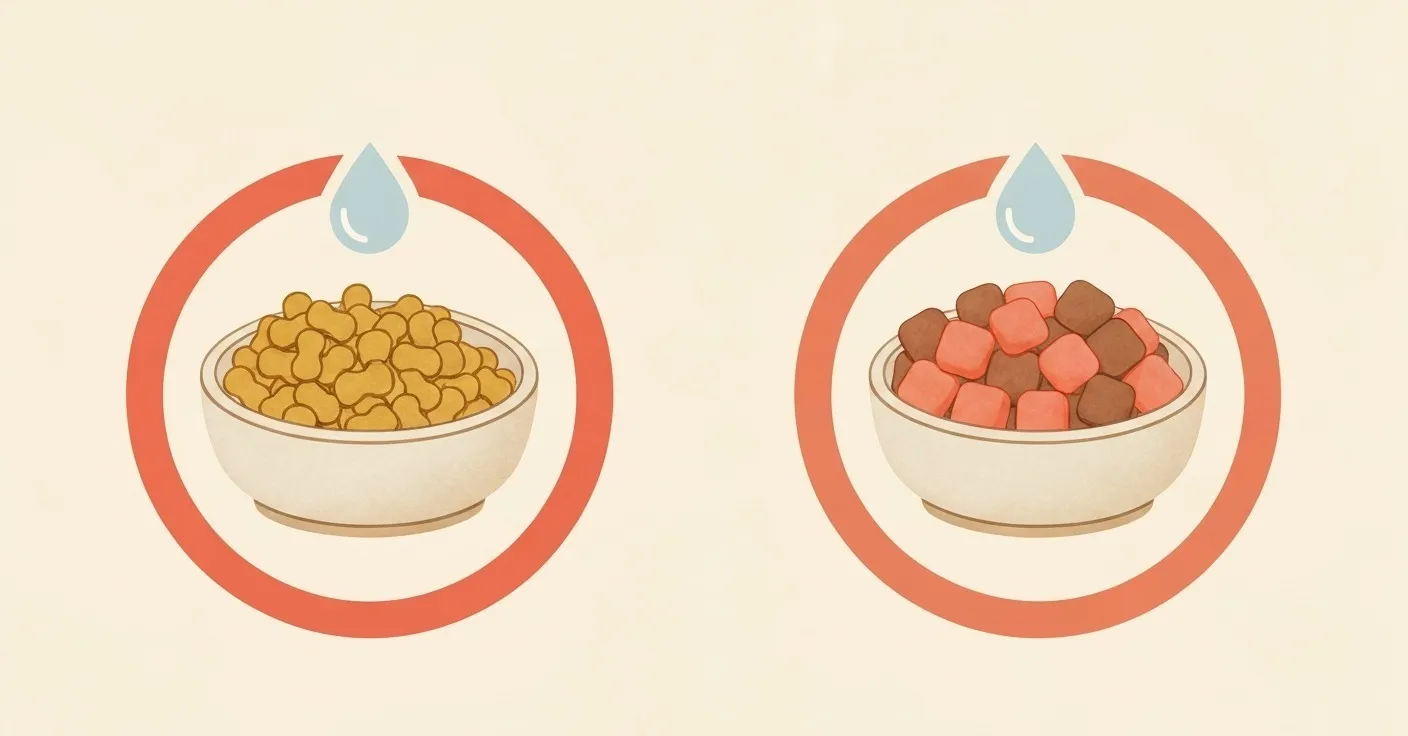
That detail is where most shoppers get tripped up. A dry kibble might be 32% protein with 10% moisture. A wet pâté next to it might be 10% protein with 78% moisture. The kibble looks like it has more than three times the protein. It doesn’t. Once you strip the water out, both foods sit in roughly the same neighborhood.
The dry-matter conversion (with a worked example)
The formula is just arithmetic most people don’t bother doing in a store aisle.
Dry-matter protein % = (as-fed protein % ÷ (100 – moisture %)) × 100
Run the two foods from above through it:
- Dry kibble: 32 ÷ (100 – 10) × 100 = 32 ÷ 90 × 100 = 35.6% on a dry-matter basis.
- Wet pâté: 10 ÷ (100 – 78) × 100 = 10 ÷ 22 × 100 = 45.5% on a dry-matter basis.
The wet food, which looked like a slacker on the shelf, is actually delivering more protein per gram than the kibble. Most quality wet foods score higher than most kibbles once you do the conversion, because kibble needs a starchy binder to extrude and hold its shape. There’s a structural ceiling on how much protein fits in a dry pellet, and it sits around 40–45% dry matter for most extruded foods (Zoran, 2002; Verbrugghe & Hesta, 2017).
You can run the same conversion for fat and fiber. Do it once at home and write the dry-matter numbers on a sticky note inside your pantry.
Why this matters specifically for cats
Cats are obligate carnivores. Their metabolism is built around protein as a primary energy source, not as a backup macronutrient (Eisert, 2011; Verbrugghe & Hesta, 2017). The AAFCO minimum for adult cat maintenance is 26% on a dry-matter basis, which is a floor, not a target. Feral cats, who get to choose, eat diets that run roughly 50–60% protein, around 30% fat, and under 10% carbohydrate on a dry-matter basis (Plantinga et al., 2011). Most commercial dry foods sit well below that protein number and well above that carb number, and the dry-matter math is the only way to see it clearly.
What ingredient order really means (and where it lies)
The ingredient list is sorted by weight before the food is cooked. That single legal detail explains most of the confusion on cat food packaging.
Whole “chicken” is roughly 70% water. By the time it’s been cooked into kibble, much of that mass has evaporated. “Chicken meal” is already rendered and dried before it goes into the recipe, so its listed weight reflects something close to its final contribution. A bag listing chicken meal first often delivers more actual chicken protein than a bag listing whole chicken first, even though the second bag sounds more wholesome (Hand & Lewis, 2010).
This isn’t a scandal. It’s just how the rule works. Once you know it, the front-of-bag claim “with real chicken” stops doing the heavy lifting it’s designed to do.
The fragmentation trick
The other quirk worth knowing is fragmentation. If a manufacturer wants their first ingredient to be a protein but they’re using a lot of corn or peas to hit a price point, they can split that single starch into multiple sub-ingredients. So instead of “corn” (which would weigh more than the chicken and have to go first), the label reads:
Chicken, corn meal, corn gluten meal, corn bran, chicken fat…
The three corn fractions, recombined, would outweigh the chicken. Listed separately, they get pushed down the panel and the chicken keeps the top spot. This is legal and common, and it’s why the old “look at the first three ingredients” rule is so unreliable on its own. The same trick is done with peas, lentils, and potatoes in grain-free formulas: pea protein, pea fiber, pea starch (Hill et al., 2009; Vester et al., 2010).
Rule of thumb: when you see two or three variations of the same plant within the first eight slots, treat them like a single ingredient and mentally move them up.
AAFCO statements: the one sentence that legally means something
Somewhere on every complete pet food, usually in small print on a side panel, is a sentence that begins “[Brand] is formulated to meet the nutritional levels established by the AAFCO Cat Food Nutrient Profiles for…”
That sentence is the most legally precise statement on the package, and the most ignored by shoppers. Two parts matter:
-
“Complete and balanced for adult maintenance” (or growth, or all life stages) means the food meets AAFCO’s full nutrient profile for that life stage and can be fed as the sole diet. Anything less, such as “for intermittent or supplemental feeding only,” means the food is a topper, a treat, or a therapeutic product, not a meal.
-
How completeness was determined. Formulation means the food was designed on paper to hit the nutrient profile based on ingredient analysis. Feeding trials means cats were actually fed the food, monitored over a defined period (usually 26 weeks for maintenance), and showed acceptable bloodwork, body weight, and clinical signs. Feeding trial language is stronger, because formulation can meet a number on paper while the cat can’t actually absorb or use what’s in the bag (NRC, 2006; AAFCO, 2024).
A food labelled “for supplemental feeding only” isn’t necessarily bad. Many bone broths, freeze-dried toppers, and treats fall into this bucket. They just aren’t a meal.
Animal protein, plant protein, and why it matters more for cats
Dogs are flexible omnivores. Cats aren’t. Arginine, the sulphur-containing methionine, and the conditionally essential taurine are all required in higher amounts in cats than in dogs, and the cat’s metabolism can’t down-regulate protein catabolism the way an omnivore’s can (MacDonald, Rogers & Morris, 1984; Eisert, 2011).
This matters at the label because plant proteins consistently score lower on amino acid completeness for cats. Pea protein concentrate, for instance, is high in crude protein but low in methionine and contains no taurine at all. Corn gluten meal contributes protein on paper but is poorly utilised. The crude protein number on the guaranteed analysis says nothing about whether the cat can actually use what’s in there.
Two practical label signals tell you whether the protein is doing real work. First, the first three named ingredients should include at least one animal protein (whole meat, meat meal, organ meat, fish, fish meal, or eggs). Second, the ingredient list should not lean heavily on plant protein concentrates (pea protein, soy protein isolate, potato protein, corn gluten meal) within the first eight ingredients.
Knowing what supplements add to a clean base diet is part of the same skill. Probiotics support gut microbial balance, which helps maintain digestive regularity and hairball passage (Hand & Lewis, 2010; Laflamme, 2018). A powder like Petterm Probiotic Hairball Control Powder mixes into a clean-label wet food without flavour masking or thickeners. For more on probiotic logic in cats, the article on probiotics for cats covers which strains have feline evidence behind them.
Taurine claims and how to verify them
In the late 1980s, the link between taurine deficiency and feline dilated cardiomyopathy reshaped the pet food industry (MacDonald, Rogers & Morris, 1984). Every complete-and-balanced cat food sold in the U.S. is now required to include supplemental taurine, and you should see it on the ingredient list, usually toward the end where vitamins and minerals appear.
Find the word taurine on the panel. If it isn’t there on a food labelled for adult cat maintenance or all life stages, that’s a returnable bag. The page on taurine for cats covers the mechanisms in plain language.
Decoding the marketing words
Most front-of-bag adjectives have no regulatory teeth, but a handful do.
- “Natural”: AAFCO-defined. Ingredients are derived from plant, animal, or mined sources and haven’t been subjected to chemically synthetic processes (added synthetic vitamins and minerals are allowed).
- “Organic”: USDA-defined, with tiers (“100% organic,” “organic,” “made with organic ingredients”). Says nothing about nutritional adequacy for cats.
- “Human grade”: Has teeth only if every ingredient and the manufacturing facility meet human-food standards. Most claims on pet food are technically out of compliance with AAFCO’s strict reading, but enforcement varies by state.
- “Grain-free”: No regulatory definition. Means no corn, wheat, rice, oats, or barley. Doesn’t mean low-carb. Many grain-free foods are higher in starch because peas, potatoes, and tapioca step in (Laflamme, 2018; AAFCO, 2024).
- “With real chicken”: The 3% rule. The food must contain at least 3% of that ingredient.
- “Chicken recipe” or “chicken dinner”: The 25% rule. At least a quarter of the food (excluding water for processing) must be chicken.
- “Chicken cat food” (no qualifier): The 95% rule. At least 95% of the food must be the named ingredient.
Reading those tiers backward is one of the fastest ways to evaluate a front-of-bag claim in three seconds.
A 30-second shopping workflow
Here’s what to do in a store aisle, in order.
- Flip the bag. Find the guaranteed analysis. Note the protein, fat, and moisture percentages.
- Convert to dry matter if comparing wet to dry. For two dry foods with similar moisture (8–12%), comparison can be done as-fed.
- Find the AAFCO statement. Confirm it says complete and balanced for your cat’s life stage, and note whether it’s formulation or feeding-trial language.
- Scan the first six ingredients. Animal protein in the top three? Watch for fragmented plant ingredients and recombine them mentally.
- Find taurine on the ingredient list. It should be there.
- Check the calorie content against your cat’s daily energy needs. A 4-kg indoor adult cat usually sits in the 180–240 kcal/day range.
- Look at the manufacturer line. Is it made by the brand, or by a co-packer?
Seven steps, most of them visual scans, all doable without leaving the aisle. For the related question of which wet foods tend to score well on those criteria, the article on best wet food for indoor cats goes brand by brand through the common options.
Frequently asked questions
Is a higher protein percentage always better for cats?
Generally yes, within reason, because cats are obligate carnivores and use protein as a primary energy source (Eisert, 2011; Verbrugghe & Hesta, 2017). But read the percentage on a dry-matter basis, and remember the source matters as much as the number. A 40% dry-matter food built on chicken meal and fish meal is more useful than a 45% dry-matter food built on pea and corn gluten concentrate.
What’s the difference between “chicken” and “chicken meal”?
Whole chicken is fresh meat, weighed before cooking, when it’s about 70% water. Chicken meal is rendered, dried, and ground chicken, weighed in its dry form. The meal version is more concentrated, so a bag listing chicken meal first usually contains more actual chicken protein than a bag listing whole chicken first (Hand & Lewis, 2010).
Are by-products bad?
Not inherently. AAFCO defines animal by-products as the non-rendered parts other than meat, including organs, blood, and bone. Liver, heart, and kidney are nutritional powerhouses with amino acid profiles that match or exceed muscle meat. The reputation problem is about variability and disclosure: “chicken liver” is more transparent than “poultry by-product meal,” even though both can be high quality if sourced well (Hill et al., 2009).
Does grain-free mean lower carb?
No. Grain-free means no corn, wheat, rice, oats, or barley. Many recipes replace those grains with peas, lentils, potatoes, or tapioca, which can be similar or higher in starch. The dry-matter carbohydrate calculation is more useful than the grain-free claim.
How do I estimate carbs from the guaranteed analysis?
Add up protein, fat, fibre, moisture, and ash (assume 6–8% if not listed). Subtract that total from 100. The remainder is roughly the carbohydrate content. Convert to dry matter for a fair comparison.
What does “complete and balanced” actually guarantee?
That the food meets AAFCO’s minimum nutrient profile for the life stage on the label, either by formulation or feeding trial. It doesn’t guarantee the protein is highly digestible or that the amino acid profile is ideal. It’s a floor, not a ceiling (NRC, 2006; AAFCO, 2024).
Is wet food better than dry?
For most cats, particularly indoor cats prone to urinary issues or weight gain, wet food has structural advantages. Higher moisture helps maintain urinary tract health, and the higher protein-to-carb ratio more closely matches feline metabolism (Zoran, 2002; Plantinga et al., 2011). A mixed approach often works well in practice.
When to contact your veterinarian
Most label-reading questions are home-managed. You can switch foods, run dry-matter calculations, and rebuild your cat’s pantry on your own without veterinary involvement, especially for healthy adult cats with stable weight and normal energy.
It becomes a vet conversation when the cat’s body says the diet isn’t working: chronic weight loss, frequent vomiting beyond occasional hairballs, dull coat, appetite changes, increased thirst and urination, or muscle wasting along the spine and hips. Suspected taurine deficiency (lethargy, breathing difficulty, vision changes) is a same-day call. Cats with diagnosed conditions such as chronic kidney disease, diabetes, IBD, or hyperthyroidism should have any major dietary change discussed with the veterinary team first, because label decisions intersect with the medical plan.
References
-
AAFCO (2024). Official Publication. Association of American Feed Control Officials, Champaign, IL.
-
NRC (2006). Nutrient Requirements of Dogs and Cats. National Research Council of the National Academies, Washington, DC.
-
Verbrugghe, A., & Hesta, M. (2017). “Cats and carbohydrates: the carnivore fantasy?” Veterinary Sciences, 4(4), 55.
-
Zoran, D.L. (2002). “The carnivore connection to nutrition in cats.” Journal of the American Veterinary Medical Association, 221(11), 1559–1567.
-
Plantinga, E.A., Bosch, G., & Hendriks, W.H. (2011). “Estimation of the dietary nutrient profile of free-roaming feral cats: possible implications for nutrition of domestic cats.” British Journal of Nutrition, 106(S1), S35–S48.
-
Eisert, R. (2011). “Hypercarnivory and the brain: protein requirements of cats reconsidered.” Journal of Comparative Physiology B, 181(1), 1–17.
-
MacDonald, M.L., Rogers, Q.R., & Morris, J.G. (1984). “Nutrition of the domestic cat, a mammalian carnivore.” Annual Review of Nutrition, 4, 521–562.
-
Vester, B.M., et al. (2010). “Influence of dietary macronutrient intake on whole-body protein turnover, energy expenditure, body composition and physical activity in lean cats and overweight cats.” British Journal of Nutrition, 103(8), 1135–1144.
-
Hill, R.C., et al. (2009). “Apparent and true digestibility of dietary protein in dogs and cats.” Journal of Animal Physiology and Animal Nutrition, 93(4), 491–500.
-
Laflamme, D.P. (2018). “Pet food safety: dietary protein.” Topics in Companion Animal Medicine, 23(3), 154–157.
-
Hand, M.S., & Lewis, L.D. (2010). Small Animal Clinical Nutrition, 5th ed. Mark Morris Institute, Topeka, KS.
-
Verbrugghe, A. (2014). “The carnivore connection revisited: feline carbohydrate metabolism.” Companion Animal Nutrition Summit Proceedings.
Researched and reviewed by the Petterm Editorial Team · Last reviewed May 2026
This article is for educational purposes and is not veterinary medical advice. Petterm products are not intended to diagnose, treat, cure, or prevent any disease. Results may vary. Always consult your veterinarian before introducing a new supplement, especially if your cat has an existing condition, takes medication, is pregnant, or is under 12 weeks old.