


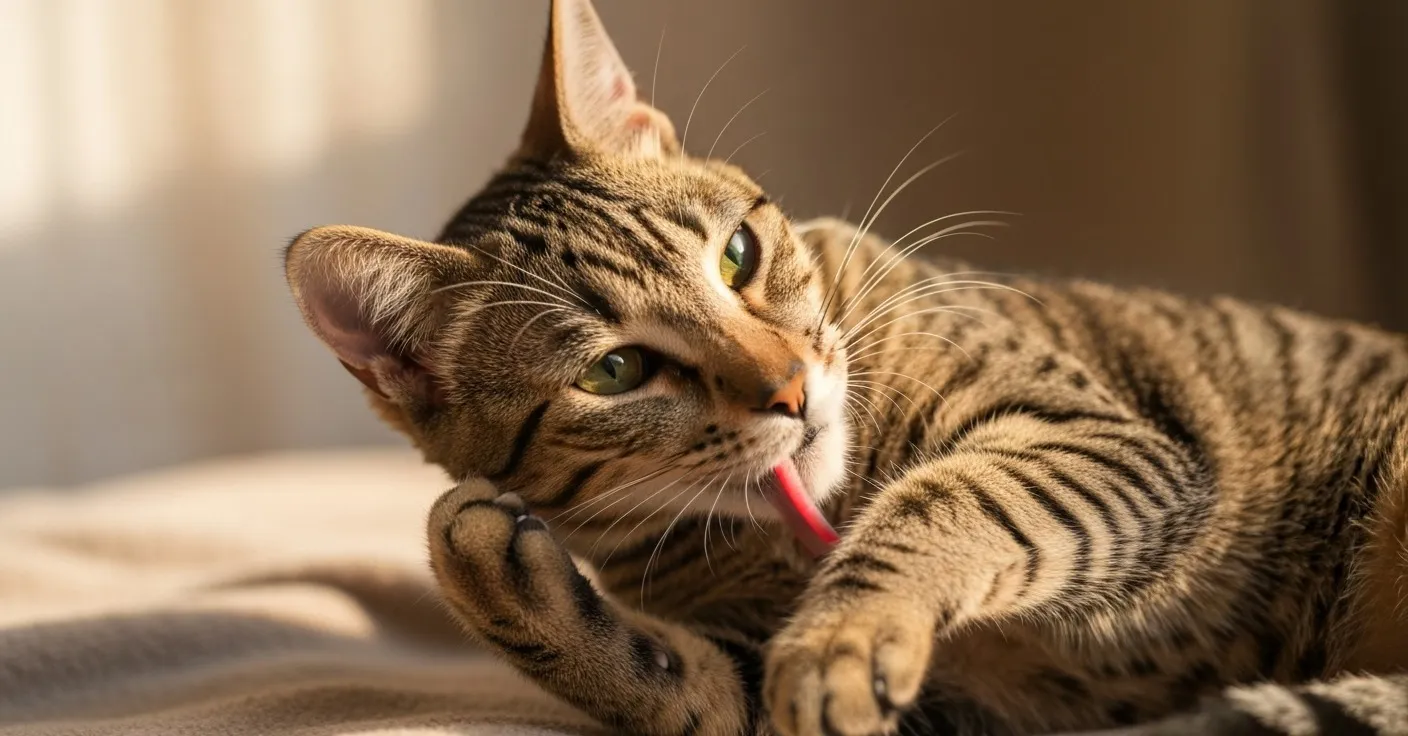
The first time I really had to argue with another vet about a cat’s diagnosis, it was over a four-year-old chocolate-point Siamese named Miso. His owner had been told three times across two clinics that Miso was “stressed” — a move two years earlier, a new baby last spring, then a renovation in the autumn. Each visit ended with a Feliway recommendation and a gentle suggestion to consider an SSRI. Miso’s flanks and belly had gone from lush to suede to almost bald, and his owner was on the verge of believing she’d somehow caused it.
I asked her to bring in a sample of the fur he was pulling, did a tape strip, and ran a flea comb. The fur shafts were broken short and clean — not pulled from the root — which is what licking and chewing leave behind. The flea comb came up empty. I asked her to commit to an eight-week elimination diet using a hydrolyzed protein. Six weeks in, Miso’s belly was downy again. He hadn’t needed a behaviorist. He’d needed a different bowl of food.
The reflex to call overgrooming a stress problem is older than the dermatology research that should have replaced it. Modern feline dermatology now treats psychogenic alopecia as a diagnosis of exclusion, not a first guess, because the great majority of self-traumatized cats turn out to have an allergy or an underlying pain source driving the behavior (Waisglass et al., 2006; Heath, 2016).
What overgrooming actually looks like
A normal cat spends roughly 30 to 50 percent of its waking time grooming. That’s a lot of licking by human standards, which is part of why owners often miss the threshold where grooming has tipped into self-trauma. The signs are usually subtle for weeks before they become obvious.
Fur over the affected area gets shorter and feels coarse rather than soft, because the shafts are broken at varying lengths rather than shed cleanly. The skin underneath may look normal, slightly pink, or in advanced cases scaly and inflamed. Whiskers on the cheeks can shorten if a cat is chewing at its forelimbs aggressively. The belly often stays damp. Hairballs increase as more fur gets swallowed, which is one of the reasons digestive support like Petterm Probiotic Hairball Control Powder gets used as part of the supportive care plan while the underlying driver is worked out — it helps maintain gut transit so that the increased fur load moves through rather than backing up.
What you almost never see, in a cat that’s overgrooming, is the cat doing it in front of you. They’re remarkably private about it. Owners often find the bald patch first and the behavior second. This is part of why owners get talked out of believing what they’re seeing — the cat looks calm and content during the consult, so the conclusion gets pinned on “stress when you’re not home.”
The three-axis decision tree
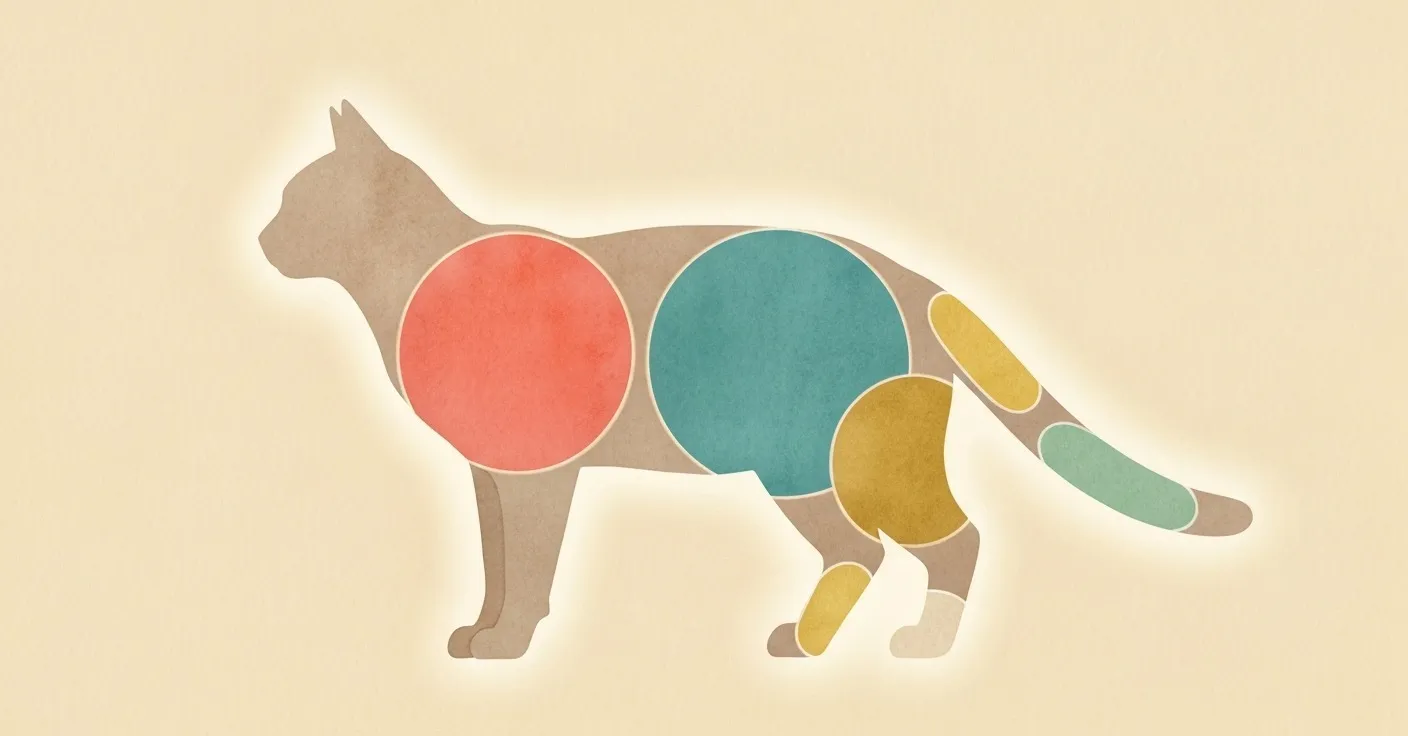
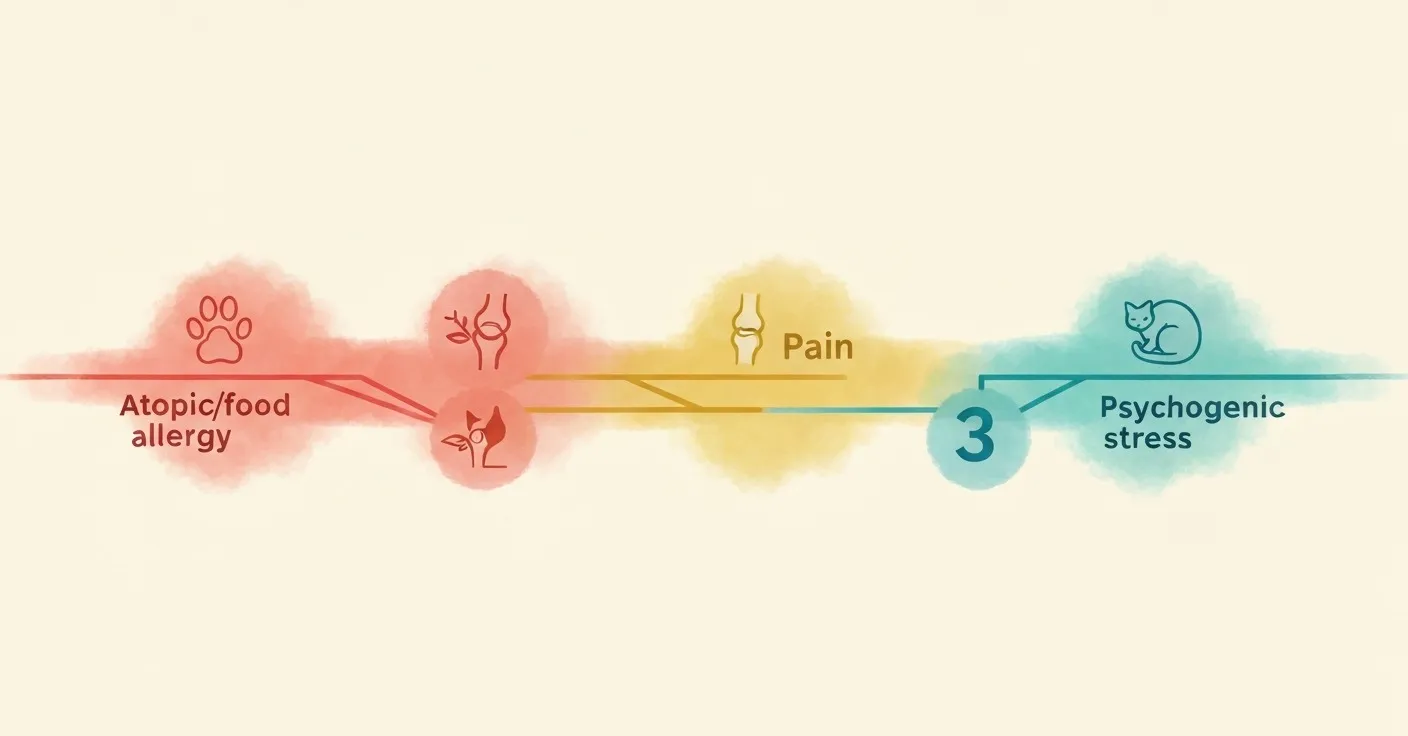
Most modern feline dermatology textbooks now frame self-induced alopecia as a three-axis problem (Halls, 2009; Heath, 2018). The job of the exam is to work through the axes in order of statistical likelihood rather than in the order that fits a particular narrative.
The three axes are: allergic skin disease, referred pain, and primary behavioral causes. They are not mutually exclusive. A cat with feline atopic syndrome can also develop secondary anxiety about the licking ritual itself, which is part of why the behavioral story has held on for so long even as the evidence has shifted underneath it.
The clinical work proceeds by ruling out the medical axes first, because they are both more common and more treatable than primary psychogenic disease. A 2006 review in the Journal of the American Animal Hospital Association found that of cats originally referred with a presumptive diagnosis of psychogenic alopecia, only about 10 percent had a purely behavioral cause once dermatologic and pain workups were complete. The remaining 90 percent had an underlying medical driver (Waisglass et al., 2006).
Axis one: allergic skin disease
This is, statistically, the most common driver in cats presenting with non-flea-related self-induced alopecia. The International Committee on Allergic Diseases of Animals consolidated feline atopic syndrome (FAS) as a clinical entity in the 2010s, with subtypes corresponding to environmental allergy, cutaneous adverse food reaction, and flea bite hypersensitivity (Olivry et al., 2010; Mueller et al., 2016).
The pattern is suggestive but not diagnostic on its own. Allergic cats often groom symmetrically — both flanks, the inner thighs, the lower belly — and the affected skin underneath is frequently pink to mildly inflamed but not raw. The distribution reflects what a cat can comfortably reach with its tongue. Cats with severe atopy may also show miliary dermatitis (a scatter of tiny scabs along the dorsum), eosinophilic plaques, or chin acne, but these don’t have to be present for allergy to be the cause.
The workup proceeds by elimination. The first step is strict flea control, because flea bite hypersensitivity is by far the easiest allergic cause to address and remains one of the most under-treated. A single flea bite per week can sustain self-trauma in a sensitized cat (Verlinden et al., 2006), which is why owners who say “I never see fleas” are often missing the point. The standard is an effective monthly product applied to every cat and dog in the household for at least eight to twelve weeks, regardless of indoor or outdoor status.
If self-trauma persists after flea control is established, the next step is a strict eight-week elimination diet using either a novel protein the cat has never eaten or a hydrolyzed protein where the molecules are too small to trigger an immune response. The diet has to be exclusive. One treat, one fragment of human food, one shared bowl with another cat eating ordinary food, will invalidate the trial. This is the part most owners find hard, and it’s also where the diagnosis most often gets made or missed (Mueller et al., 2016).
If both flea control and elimination diet have been pursued cleanly and the overgrooming continues, environmental atopy moves up the list. That workup is typically referred to a dermatologist for intradermal or serum allergy testing and a decision about allergen-specific immunotherapy.
Axis two: referred pain
This is the axis that the older “is the cat stressed?” framing missed almost entirely, and the one that has shifted the most in the last decade. Cats lick the body region overlying a pain source. They are quiet about pain in ways that mask its presence, and overgrooming is one of the few outward signals (Klinck et al., 2013).
The three pain sources most commonly underlying overgrooming, in rough order of frequency in cats over eight years old:
Osteoarthritis. Radiographic surveys have found degenerative joint disease in 60 to 90 percent of cats over twelve years of age, and it begins quietly in middle age (Hardie et al., 2002; Bennett et al., 2012). A cat licking obsessively at one elbow, one hip, or down a single hind limb is much more likely to have arthritis in that joint than to have a behavioral focus there. Distribution that is one-sided or focused on a single limb is a strong pain signal until proven otherwise.
Feline idiopathic cystitis (FIC). Cats with bladder inflammation will sometimes lick the lower belly and the area in front of the genitals persistently. This often gets misread as “stress overgrooming” because FIC itself has a strong stress component, so the picture is confusingly mixed. A urinalysis and an abdominal exam are part of any sensible workup for caudal-belly grooming, especially in male cats and in any cat with a history of straining to urinate.
Dental and oral pain. Cats with chronic gingivostomatitis or fractured teeth sometimes overgroom the face, paws, or shoulders. The mechanism isn’t fully understood, but the pattern of facial-region grooming combined with subtle changes in appetite or food preference should send the conversation to the mouth.
A pain trial is part of the diagnostic process when arthritis is suspected. Under veterinary supervision, a short course of an appropriate analgesic — never a human NSAID, which can be toxic to cats — can reveal whether grooming reduces in parallel with the pain. Sawyer and Howe (2018) emphasize that response to analgesia is one of the most useful diagnostic tools for occult feline osteoarthritis, precisely because the imaging and the clinical signs often disagree in cats.
Axis three: psychogenic alopecia
Psychogenic alopecia is real, but it is uncommon and it is a diagnosis of exclusion. Once flea control, elimination diet, and a pain workup have been done cleanly and the cat is still self-traumatizing, the behavioral axis takes priority.
The classic picture is a cat with bilateral, symmetric hair loss on accessible areas — the medial forelimbs and the ventral abdomen are most typical — in the context of an identifiable environmental stressor. Oriental breeds, particularly Siamese, Burmese, and Abyssinian, are over-represented in the literature on psychogenic cases (Waisglass et al., 2006; Heath, 2016). The stressors that show up most often in case series are household conflicts between cats, a recent change in residence or routine, loss of a companion animal or person, and chronic environmental under-stimulation.
Treatment of true psychogenic alopecia is built around environmental enrichment rather than medication first. Vertical space, predictable feeding and play routines, multiple separated resource stations (food, water, litter, resting) for each cat in a multi-cat household, and pheromone diffusers like Feliway Optimum are the foundation (Heath, 2018). Where these are insufficient, an SSRI such as fluoxetine can be added under veterinary supervision, with the understanding that response time is six to eight weeks and that the medication supports rather than replaces the environmental work.
The risk of jumping to this axis first is that an allergy or pain source goes untreated for months while a cat is on a psychiatric medication that doesn’t address the actual driver. This is the specific failure mode I see most often when overgrooming cases bounce between clinics without a structured workup.
Using distribution patterns to triage
Where a cat is grooming is one of the most useful pieces of information you can bring to the consult. The pattern is rarely diagnostic on its own, but it shifts the prior probability across the three axes meaningfully.
Symmetric belly, inner thighs, and medial forelimbs. Most consistent with allergic skin disease or psychogenic alopecia. The two can look identical on distribution alone, which is why the workup ordering matters.
Base of the tail. Classic flea bite hypersensitivity pattern, even when no fleas are visible. This area is also a thermoregulatory site and a referred pain location for lumbosacral disease in older cats, so it isn’t always allergy — but flea control is the first move regardless.
One limb, one flank, or one hip. Strong pain signal. Asymmetric grooming should trigger an orthopedic exam and a careful palpation rather than a behavioral workup.
Lower abdomen in front of the genitals. Consider feline idiopathic cystitis, particularly in male cats and in any cat with a history of urinary signs.
Face, head, and shoulders. Atopy and food allergy commonly affect the head and neck in cats. Persistent face-grooming with subtle changes in appetite should also raise oral pain on the list.
These are starting points, not endpoints. Many cats present with mixed patterns, and many have more than one driver running concurrently.
A practical trial protocol
A reasonable home-to-clinic sequence for a cat overgrooming without obvious open wounds or systemic signs, in coordination with your veterinarian, looks roughly like this:
Weeks 1 to 4: Flea control on every animal in the household. Use a veterinarian-recommended product applied consistently. Treat the environment if there has been any history of flea activity. Document grooming sites and severity with weekly photos in the same lighting.
Weeks 5 to 12: Elimination diet trial. Switch to a hydrolyzed or novel protein diet under veterinary direction. No treats, no shared bowls, no flavored medications. Keep flea control going in parallel. Re-evaluate at the eight-week mark.
Weeks 8 to 12, in parallel for senior cats: Pain workup. Radiographs of suspect joints, urinalysis, and an oral exam under sedation if indicated. A short analgesic trial under veterinary supervision can clarify whether arthritis is contributing.
Weeks 12 onward: Environmental enrichment trial. If the medical axes have been worked cleanly and grooming persists, restructure the home environment with separated resources, vertical territory, and structured play. Add pheromone diffusers. Consider referral to a veterinary behaviorist before adding pharmacological agents.
Through any of these phases, increased hairball burden is a predictable side effect of the licking volume. Digestive support that helps maintain healthy transit can reduce the secondary GI signs while the underlying cause is being identified. The comprehensive guide to hairball management in cats covers the mechanical and nutritional pieces of this in more detail, and the overview of probiotic strains for cats explains why specific bacterial profiles matter for cats with grooming-related fur ingestion.

Frequently asked questions
How do I tell if my cat is overgrooming or just shedding heavily?
Run a hand against the grain of the fur on the area you’re worried about. Shedding leaves the undercoat intact and the guard hairs even. Overgrooming leaves shafts of varying lengths, sometimes a velvety stubble where there should be guard hairs, and occasionally bare skin underneath. A flea comb is another quick test — if the teeth catch and pull tufts that look chewed off at the tip rather than rooted, that’s self-trauma.
Can stress alone cause my cat to go bald?
Possibly, but it is uncommon and it is the last axis a careful workup arrives at, not the first. Most cats once labeled as having psychogenic alopecia turn out to have an allergic or painful driver once flea control, an elimination diet, and a pain workup are done properly (Waisglass et al., 2006). If your vet has gone straight to a stress diagnosis without those steps, it’s worth asking about the rest of the differential.
My cat only licks one leg. What does that mean?
Asymmetric grooming, especially focused on a single limb or a single joint area, is much more likely to be pain than behavior. Orthopedic disease in cats is dramatically under-recognized — radiographic surveys find joint changes in the majority of cats over twelve years old (Hardie et al., 2002). A focused orthopedic exam and an analgesic trial under veterinary supervision should be on the table.
Will an elimination diet actually fix this?
It won’t “fix” anything in the medical sense — what it does is help you identify whether a food protein is driving the immune response that is, in turn, driving the grooming. Roughly a third to a half of allergic cats in published case series respond to a properly conducted elimination diet (Mueller et al., 2016). If the trial works, long-term dietary management supports skin comfort. If it doesn’t, you’ve ruled out food allergy cleanly and the workup moves to environmental atopy or other axes.
Are some breeds more prone to overgrooming?
Oriental breeds (Siamese, Burmese, Abyssinian, Tonkinese) appear more frequently in psychogenic alopecia case series, and they may also be over-represented in some allergic phenotypes (Heath, 2016). Breed alone isn’t a diagnosis, but it does shift the prior probability slightly. A bald-bellied Siamese still gets the same structured workup as any other cat.
Should I put an Elizabethan collar on my cat to stop the licking?
An e-collar can be useful short-term to allow open wounds to heal or to prevent further trauma during a flare, but it doesn’t address why the cat is licking. Long-term collar use without a diagnostic workup tends to mean the underlying driver progresses unseen. Use them as a bridge while you and your vet identify and address the cause.
How long does it take for fur to grow back once the cause is treated?
Once the driver is addressed, cats with self-induced alopecia typically begin regrowing fur within four to eight weeks, with full regrowth by twelve to sixteen weeks depending on coat type and how chronic the area is. Heavily scarred or chronically inflamed skin may regrow more slowly or with subtle color changes.
When to contact your veterinarian
Watch and support at home if: the overgrooming is mild, you’ve started consistent flea control on every animal in the household within the past two to four weeks, the skin underneath looks intact (no open sores, no scabs, no oozing), and your cat is eating normally, using the litter box normally, and engaging with the household. Continue photographing affected areas weekly in the same lighting so you can track whether things are improving, stable, or worsening. If there is no measurable change after two to three weeks of consistent flea control, move to the next tier.
Call your vet within 24 to 48 hours if: the overgrooming is persistent or worsening after at least four weeks of consistent flea control, the affected area is expanding, you’re seeing pink or inflamed skin underneath the broken fur, hairballs have increased in frequency or size, your cat is grooming asymmetrically (one limb, one hip, one flank), there are signs of urinary trouble alongside lower-belly grooming, or your cat is older than eight and you suspect joint pain. Your vet may run a skin scrape, a tape strip cytology, a urinalysis, or recommend an elimination diet and a structured pain workup before any behavioral diagnosis is considered.
Seek same-day or emergency veterinary care if: there are open wounds, raw skin, or bleeding from the grooming sites; your cat has stopped eating or drinking; there is straining to urinate, vocalizing in the litter box, or blood in the urine; your cat is hiding, lethargic, or otherwise behaving differently from baseline; or you notice rapid expansion of bald areas over hours rather than days. Self-trauma severe enough to break the skin can lead to secondary bacterial infection quickly, and the combination of grooming with anorexia or urinary signs can mark a systemic problem that needs same-day evaluation.
References
-
Olivry, T., DeBoer, D.J., Favrot, C., Jackson, H.A., Mueller, R.S., Nuttall, T., & Prélaud, P. (2010). Treatment of canine atopic dermatitis: 2010 clinical practice guidelines from the International Task Force on Canine Atopic Dermatitis. Veterinary Dermatology, 21(3), 233–248.
-
Mueller, R.S., Olivry, T., & Prélaud, P. (2016). Critically appraised topic on adverse food reactions of companion animals (2): common food allergen sources in dogs and cats. BMC Veterinary Research, 12, 9.
-
Verlinden, A., Hesta, M., Millet, S., & Janssens, G.P.J. (2006). Food allergy in dogs and cats: a review. Critical Reviews in Food Science and Nutrition, 46(3), 259–273.
-
Waisglass, S.E., Landsberg, G.M., Yager, J.A., & Hall, J.A. (2006). Underlying medical conditions in cats with presumptive psychogenic alopecia. Journal of the American Veterinary Medical Association, 228(11), 1705–1709.
-
Sawyer, J.R. & Howe, L.M. (2018). Management of feline osteoarthritis: current understanding and future directions. Veterinary Clinics of North America: Small Animal Practice, 48(5), 909–925.
-
Klinck, M.P., Frank, D., Guillot, M., & Troncy, E. (2013). Owner-perceived signs and veterinary diagnosis in 50 cases of feline osteoarthritis. Canadian Veterinary Journal, 53(11), 1181–1186.
-
Heath, S. (2018). Feline Behavioral Health and Welfare. Elsevier.
-
Bennett, D., Zainal Ariffin, S.M., & Johnston, P. (2012). Osteoarthritis in the cat: how common is it and how easy to recognise? Journal of Feline Medicine and Surgery, 14(1), 65–75.
-
Hardie, E.M., Roe, S.C., & Martin, F.R. (2002). Radiographic evidence of degenerative joint disease in geriatric cats: 100 cases (1994–1997). Journal of the American Veterinary Medical Association, 220(5), 628–632.
-
Heath, S.E. (2016). Behaviour problems and welfare. In The Welfare of Cats (pp. 91–118). Springer.
-
Halls, V. (2009). The overgrooming cat: a differential approach. Feline Focus, 5(3), 14–18.
Researched and reviewed by the Petterm Editorial Team · Last reviewed May 2026
This article is for educational purposes and is not veterinary medical advice. Petterm products are not intended to diagnose, treat, cure, or prevent any disease. Results may vary. Always consult your veterinarian before introducing a new supplement, especially if your cat has an existing condition, takes medication, is pregnant, or is under 12 weeks old.