


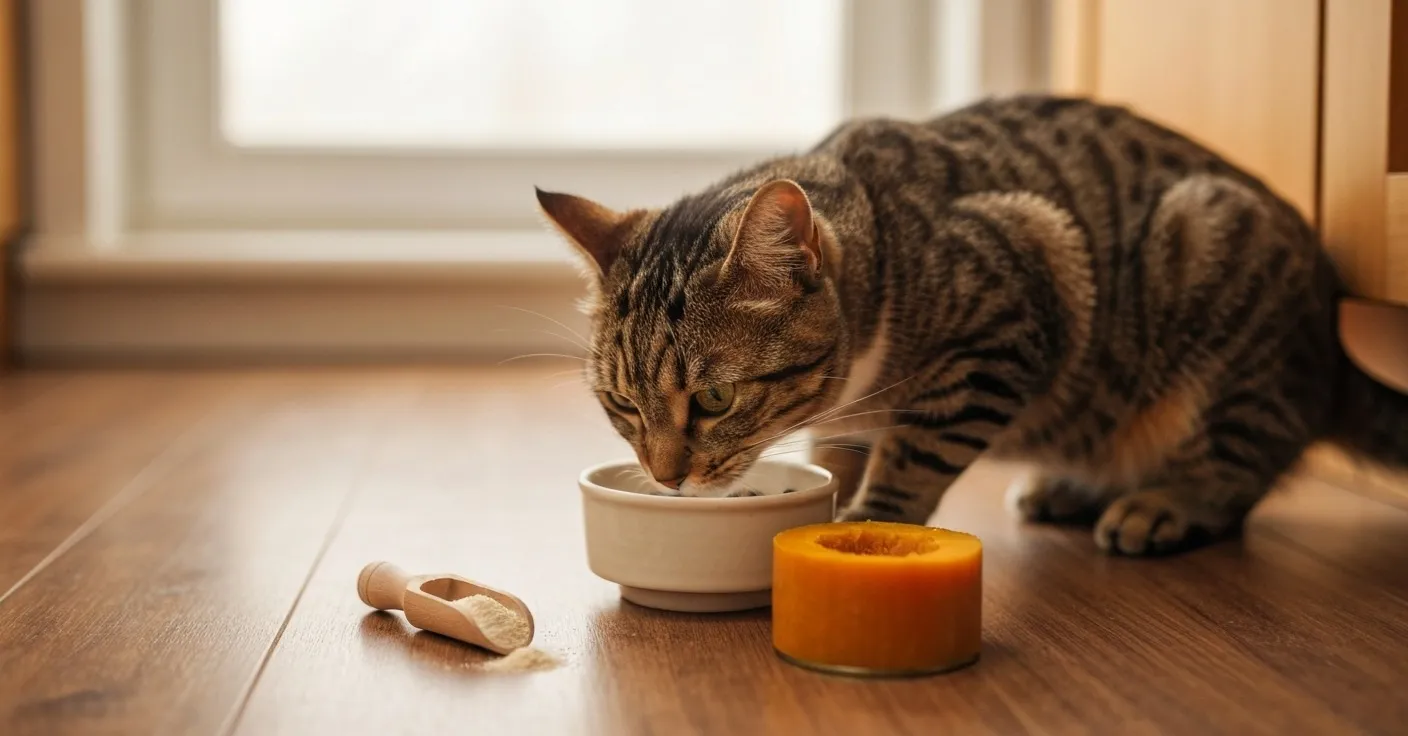
My cat Birch spent three weeks doing something I can only describe as reluctant litter box visits. He’d walk in, stay longer than usual, and emerge looking mildly wronged. Eating fine. Drinking water. No obvious distress. Just slower than normal, producing hard, infrequent output. When I described it to the vet, she asked one question before anything else: what was I feeding him?
It was a premium wet food. Good protein, clean ingredients. Almost no fiber. She suggested I add a small amount of plain psyllium husk to his meals, mixed thoroughly, with a bowl of fresh water always nearby. Ten days later Birch was himself again, trotting out of the litter box with his usual indifference.
That conversation opened something I hadn’t thought carefully about before. Cats are obligate carnivores. Their prey is muscle, organ, bone, fur. What business does a meat-eater have with fiber? More than I’d assumed. And the answer is different depending on whether your cat is straining to go, producing loose stool, or coughing up hairballs twice a week. Fiber isn’t one thing. The gap between types determines everything about what it actually does.
Why fiber matters in a carnivore’s gut
Cats evolved as hunters of small prey. Their digestive anatomy reflects it: a shorter gut than a dog’s, faster transit time, a colon microbiome built around protein fermenters more than carbohydrate fermenters. None of that makes fiber irrelevant. It changes what role fiber plays.
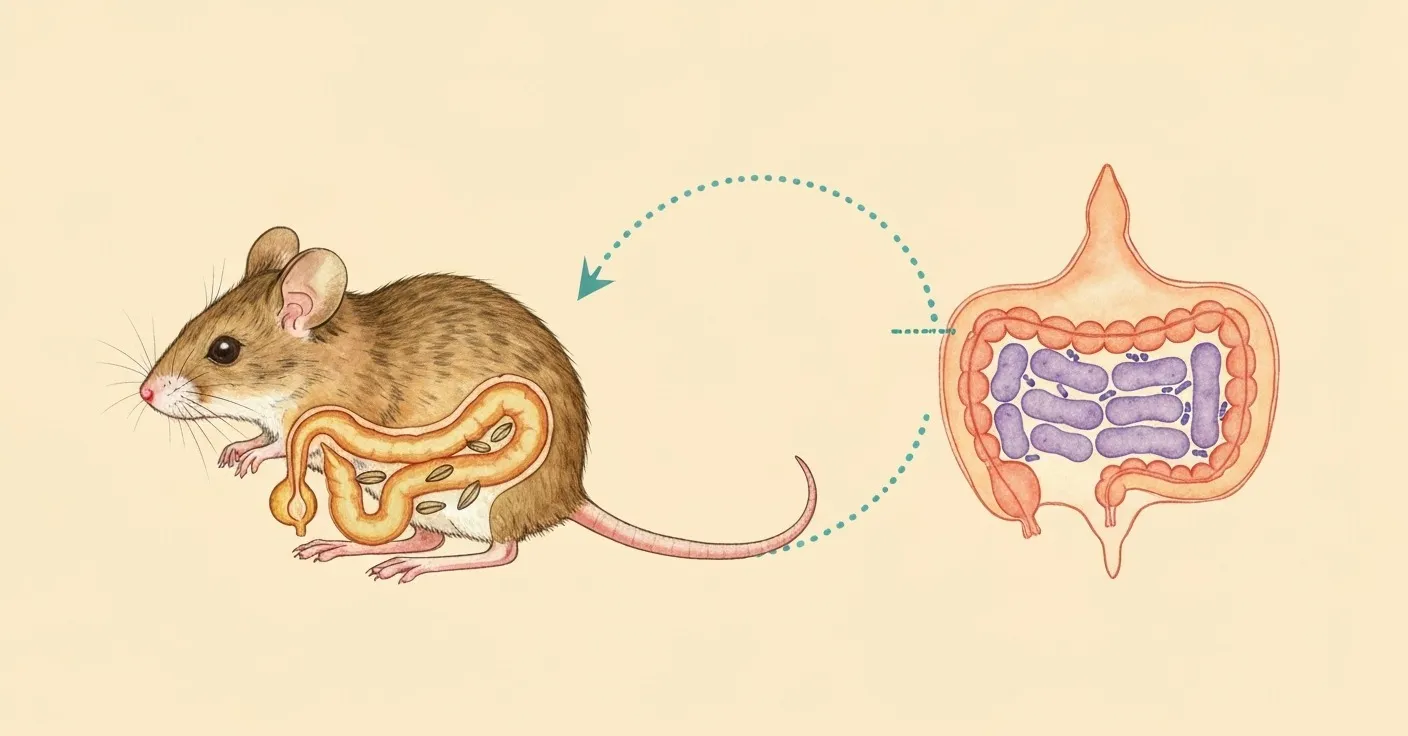
In the wild, cats don’t eat plants. But they eat whole animals, and a whole animal includes the gut contents of the prey. A mouse’s stomach holds partially digested seeds, insects, and fermentable plant material. A bird’s crop contains similar residue. Across thousands of meals, the feline gut evolved in contact with a low but steady trickle of fermentable fiber, animal-derived roughage (fur, feathers, connective tissue), and gut-content fiber from prey. That’s not the same as a bowl of vegetables, but it’s not zero either.
Commercial cat food, especially dry kibble, often provides very little of that input. Many formulas list crude fiber below 2% of dry matter. Some high-protein wet foods contain almost none. When fiber drops out entirely, the downstream effects show most visibly in stool consistency, gut motility, and hairball frequency. The digestive system doesn’t catastrophically fail. It just runs harder than it should.
Soluble vs. insoluble fiber: what actually happens in the gut
Crude fiber on a pet food label is nearly useless as a number because it collapses two physically different materials into one figure. Understanding what each type does changes how you think about every fiber source on an ingredient list.
Soluble fiber dissolves in water and forms a gel as it moves through the digestive tract. Bacteria in the colon ferment this gel and produce short-chain fatty acids (SCFAs), primarily butyrate, propionate, and acetate. Butyrate is the preferred fuel source for colonocytes — the cells lining the colon wall. When butyrate production is healthy, the gut lining stays intact, mucus production is adequate, and immune signaling remains balanced (Topping & Clifton, 2001). Soluble fiber also slows transit slightly and binds water in the colon, which moderates stool consistency in both directions. Too much water moving through produces loose stool; soluble fiber can bind some of it. Too little water in the colon produces hard stool; soluble fiber pulls some moisture in. That bidirectional buffering is unusual and useful.
Insoluble fiber doesn’t dissolve and doesn’t ferment meaningfully. It passes through largely intact, adding bulk and mechanically stimulating the gut wall’s stretch receptors. That stimulation triggers peristaltic contractions, the wave-like muscle movements that push gut contents forward. Insoluble fiber is the mechanical component of transit. It moves things along but doesn’t feed the microbiome or directly support the colon lining.
Most real fiber sources contain both types in varying ratios. Psyllium husk runs roughly 70% soluble and 30% insoluble — heavily biased toward the gel-forming end. Cellulose, used in many prescription weight-management formulas, is almost entirely insoluble. Beet pulp sits in the middle: partially fermentable, partially structural. That middle position is part of why beet pulp appears in so many commercial cat foods. It delivers modest benefits on both axes without overdoing either.
Natural fiber sources in prey vs. commercial food
The prey model is useful for framing but can be misleading about the quantity involved. Wild cats eating three or four mice per day don’t consume large amounts of plant fiber. They consume the gut contents of their prey spread across multiple small meals, fur and connective tissue providing structural roughage, and trace amounts of fermentable substrate. It’s consistent, not concentrated.
Commercial food compresses all of this into one or two meals per day. Dry food runs around 10% moisture compared to the 65-70% moisture in live prey. That dryness matters independently of fiber content: the colon needs water to keep stool soft and transit smooth, and cats on dry-only diets are working with a lower baseline than cats eating wet food. A dry-food cat’s fiber needs interact with hydration in a way that a wet-food cat’s don’t. Soluble fiber that draws water into the colon becomes more critical when the diet itself is dry.
Processing also changes fiber’s behavior. High-temperature extrusion, the method used to produce most kibble, degrades the physical structure of plant materials, including fiber. Fermentability can drop significantly after processing (Cummings et al., 1996). A food that lists beet pulp high on the ingredient list may deliver less functional prebiotic benefit than the same amount of unprocessed beet pulp would. This doesn’t make the ingredient worthless, but it tempers expectations.
Fiber for constipation: which type, how much, realistic expectations
Constipation in cats shows up as hard, infrequent stools, prolonged straining in the litter box, and occasionally defecation outside the box because the cat is uncomfortable. It’s common in older cats, in cats eating mostly dry food, and in cats that are less active.
The right fiber for constipation is primarily soluble, not insoluble. Adding cellulose to a dehydrated cat’s diet can make hard stool harder and heavier — that’s the wrong direction. Soluble fiber draws water into the colon and softens the stool matrix. It also feeds the bacteria that produce butyrate, which supports the motility contractions that move stool forward. The combination of softer stool and better motility is what resolves mild constipation.
Psyllium husk is the most studied option for this application in cats. Sechi et al. (2015) reported improved defecation frequency and stool consistency in constipated cats receiving psyllium at around 1–4 grams per day depending on body weight. The key requirement: psyllium only works when the cat is adequately hydrated. Dry psyllium in a dry meal, with inadequate water intake, can form a resistant mass and worsen things. Always pair it with wet food or added water, and ensure fresh water is constantly available.
For mild, intermittent constipation in a healthy adult cat, this approach is reasonable to try at home. For cats who haven’t produced stool in more than 48 hours, are visibly straining without result, or have recurring constipation over weeks, a veterinary evaluation is the right call before adding anything — older cats particularly can develop megacolon, which dietary fiber alone won’t address.
Fiber for diarrhea: the water-binding gel mechanism
Acute diarrhea usually isn’t a fiber problem. Infections, parasites, food intolerances, or stress are more likely causes, and those need direct treatment. But chronic or recurrent loose stool in a cat with no identified pathogen is where soluble fiber becomes genuinely useful.
The mechanism is the gel. Soluble fiber forms a viscous matrix in the colon that slows the rate at which water passes from the colon wall into the stool. When transit is too fast or the colon’s water-absorption function is impaired, stool exits wetter than it should. Slowing transit and moderating water absorption brings consistency toward normal.
The SCFA angle matters here too. Cats with chronic diarrhea often show disrupted microbiome composition with reduced fermentation capacity and lower butyrate output (Suchodolski et al., 2012). Reduced butyrate means the colon epithelium is running on less fuel, which can compromise barrier integrity and worsen the cycle. Restoring fermentable soluble fiber can partially restore SCFA production. This is why fiber and probiotics for cats are often combined — they work on overlapping but distinct parts of the same system.
Insoluble fiber is largely neutral for diarrhea and can sometimes accelerate transit if given in large amounts, which moves in the wrong direction. For diarrhea management, a moderate dose of soluble fiber is more useful than adding bulk.
Fiber for hairball transit: gut motility is the mechanism
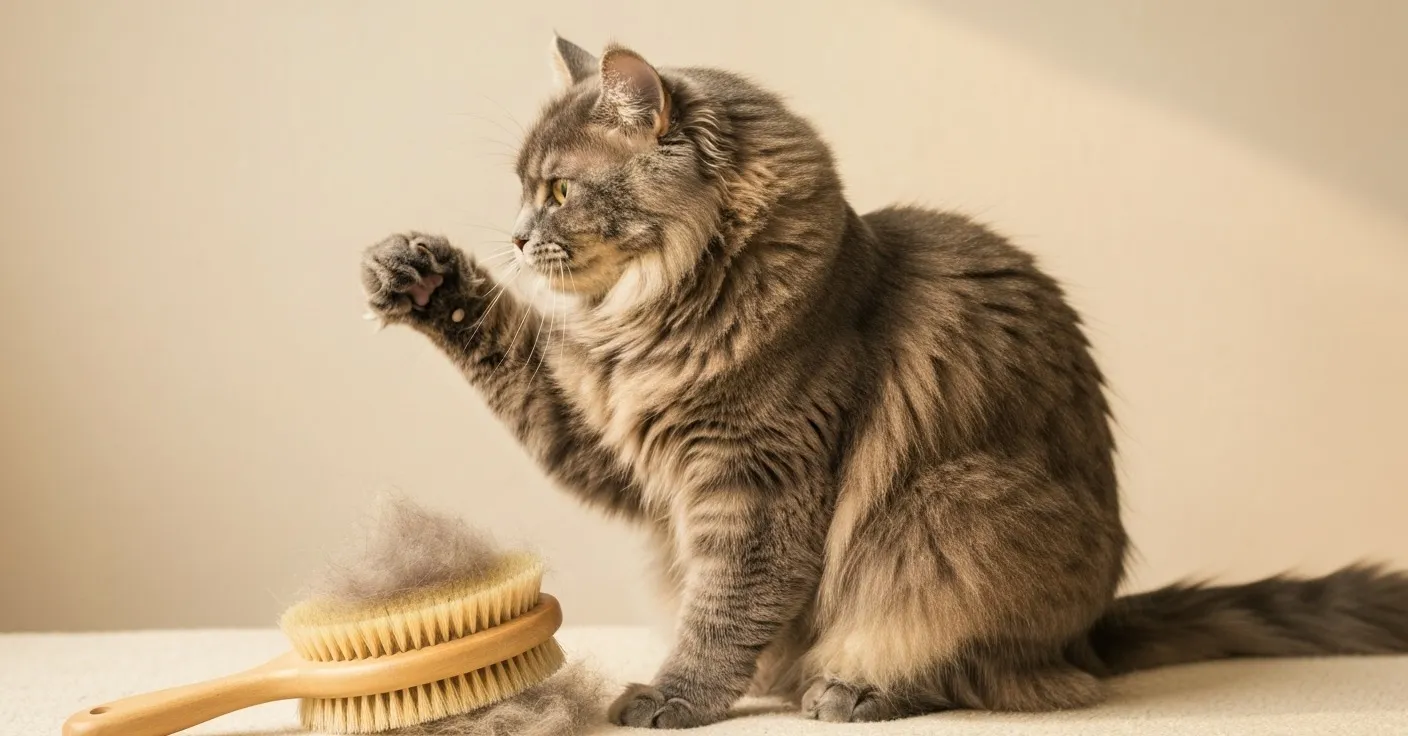
Hairballs form when fur accumulates in the stomach faster than it can be moved through the gut. Cats groom constantly. They swallow a significant amount of fur in the process. Most of the time, normal gut motility moves that fur through and it exits in stool without incident. The problem arises when motility slows, fur accumulates into a bolus, and the stomach expels it rather than passing it forward.
Fiber supports hairball management primarily by maintaining the motility that moves stomach contents into and through the intestine. Insoluble fiber stimulates mechanical peristalsis. Soluble fiber supports the SCFA-dependent signaling that drives colonic contractions and maintains the motility rhythm. The lubrication effect of a psyllium gel also reduces friction, making it easier for fur-containing material to slide through.
This is the principle behind formulas that combine psyllium with a probiotic blend. The Petterm Probiotic Hairball Control Powder pairs psyllium husk with a probiotic strain blend, addressing both the gel-lubrication side and the microbiome-motility side at the same time. It’s not a treatment for an existing blockage, but it can help maintain the conditions that prevent fur from building up in the first place. For the full picture on why cats form hairballs and what contributes to frequency, the article on hairball causes and prevention goes deeper into the anatomy and contributing factors.
Practical fiber sources: psyllium, inulin, pumpkin, beet pulp
The choice of fiber source matters more in cats than in dogs because cats have less tolerance for getting the balance wrong.
Psyllium husk is the most evidence-supported supplement for both constipation and diarrhea in cats. It’s predominantly soluble, the gel forms quickly, and it’s well-tolerated in small amounts. The practical guidance from our psyllium seed husk ingredient guide applies directly here: mix it thoroughly into wet food immediately before serving, use plain unflavored psyllium only, and start at a very small amount. Introduce gradually over a week. Too much too fast causes bloating, gas, and transient soft stool.
Inulin (from chicory root) is a highly fermentable soluble fiber and a strong prebiotic. It promotes SCFA production well, especially butyrate and propionate, and selectively feeds Bifidobacterium species. The downside at higher doses: it produces gas and bloating before it produces stool improvements. It’s useful as a microbiome-support ingredient in small amounts, less so as the primary fiber source for constipation or hairball management.
Plain pumpkin purée is the home remedy most cat owners try first. It’s a mixed soluble/insoluble source with decent water content, and many cats find it palatable enough to accept mixed into food. It’s not as concentrated as psyllium, so you need a larger volume for comparable effect, but for mild, occasional issues it’s a reasonable starting point. Always use plain pumpkin — not pie filling, which contains spices that aren’t safe for cats.
Beet pulp sits in the middle of the fermentability spectrum: partially fermentable, partially structural, well-studied in cats, and generally well-tolerated. Bueno et al. (2000) found that beet pulp produced firmer stools than pure cellulose at lower inclusion rates, which makes sense given its mixed fiber profile. It’s not something most owners would add at home, but it’s a sound ingredient to look for on commercial food labels. A food that lists beet pulp in the ingredient list is including a genuinely useful fiber source, not just filler.
Cellulose adds transit-stimulating bulk but provides almost no fermentation or lubrication benefit. It’s useful in weight-management formulas for satiety, and it can help with the mechanical component of hairball transit, but it doesn’t address the microbiome or SCFA side of gut health. Don’t mistake a high cellulose content on an ingredient list for comprehensive fiber coverage.
Frequently Asked Questions
How much fiber does my cat actually need?
There’s no AAFCO minimum for crude fiber in adult cat food. Most complete commercial diets contain 1.5–3.5% crude fiber on a dry-matter basis. For supplementation, the practical guidance is to start conservatively and adjust based on stool response over 7–10 days rather than targeting a specific gram amount. Cats with specific conditions (constipation, hairball-prone) may benefit from higher supplemental fiber; cats on high-protein, low-carbohydrate wet food diets may need less (Zoran, 2002).
Can too much fiber harm my cat?
Yes. Excessive fiber dilutes protein and calorie density, which matters a lot in an obligate carnivore. Very high fiber intakes can reduce protein digestibility and over time may compromise lean muscle maintenance, especially in older cats. Excessive insoluble fiber can also accelerate transit to the point of loose stool. Keep supplemental amounts modest and titrate based on your cat’s actual response.
Is pumpkin enough for constipation?
For mild, occasional constipation in a healthy adult cat, yes, it’s a reasonable first step. It’s not as fiber-concentrated as psyllium, so effects are modest. If pumpkin hasn’t improved things within 7–10 days, or if constipation recurs regularly, a vet conversation is appropriate — especially to rule out dehydration, anatomical causes, or developing megacolon in older cats.
My cat vomits hairballs every week. Will fiber fix it?
Fiber can support the gut motility that moves fur through the system, potentially reducing frequency. But weekly vomiting warrants a veterinary conversation to rule out other causes — inflammatory bowel disease, motility disorders, or hyperthyroidism can all look similar. Fiber and hairball-support supplements are management tools, not treatments for underlying conditions.
Does dry food vs. wet food change what fiber my cat needs?
It changes the context significantly. Cats on dry food are managing digestion with much lower baseline hydration, which makes soluble fiber’s water-binding behavior more relevant. Wet food cats typically have softer stools and more regular transit without intervention. The same fiber source at the same dose can behave differently depending on how much water the rest of the diet provides.
Are fiber supplements safe alongside probiotics?
Generally yes, and the combination is often more effective than either alone. Fermentable soluble fibers are prebiotics, meaning they feed the bacteria that probiotic supplements introduce or support. Starting one change at a time makes it easier to identify what’s working, but combining them isn’t a concern in healthy cats (Schmitz & Suchodolski, 2016).
Can I use human psyllium products like Metamucil?
Plain, unflavored psyllium husk powder is safe for cats in small amounts. The flavored versions — orange-flavored products especially — often contain artificial sweeteners including xylitol, which is toxic to pets. Use only plain psyllium husk with no added ingredients, and dose conservatively.
How long before I see results from fiber supplementation?
Stool consistency typically shifts within 7–10 days of consistent supplementation. Hairball frequency takes longer — expect 4–8 weeks of daily use before drawing conclusions. If nothing has changed by the four-week mark with appropriate dosing, fiber probably isn’t the limiting factor.
When to Contact Your Veterinarian
Fiber adjustments are a reasonable home-management tool for cats with mild, intermittent digestive symptoms. They become a medical question when certain thresholds are crossed.
Monitor and adjust at home if: your cat has occasional mildly soft or mildly firm stool, is otherwise eating and drinking normally, maintaining weight, and showing no signs of discomfort. A modest fiber change monitored over 1–2 weeks is appropriate.
Contact your vet within 48 hours if: your cat hasn’t produced stool in 48 hours or more, is visibly straining without result, is producing stool with blood or mucus, has lost weight without an obvious dietary explanation, or shows a sudden change in stool consistency that doesn’t resolve within a few days. Chronic diarrhea warrants a fecal test to rule out parasites and pathogens before any nutritional adjustment.
Seek same-day veterinary care if: your cat is straining and clearly in pain, has produced no stool in three or more days, is vomiting repeatedly, shows abdominal distension, or seems lethargic and is refusing food. Obstipation, megacolon, and intestinal obstruction are not dietary problems. They’re medical emergencies that require prompt clinical assessment.
References
-
Topping, D.L., & Clifton, P.M. (2001). Short-chain fatty acids and human colonic function: roles of resistant starch and nonstarch polysaccharides. Physiological Reviews, 81(3), 1031–1064.
-
Suchodolski, J.S., et al. (2012). Alterations in the gastrointestinal microbiome in cats with inflammatory bowel disease. PLOS ONE, 7(6), e39021.
-
Sechi, S., Polli, M., Marelli, S.P., et al. (2015). Effects of psyllium on bowel function in cats with chronic constipation. Veterinary Sciences Tomorrow, 11, 1–7.
-
Bueno, A.R., Cappel, T.G., Sunvold, G.D., et al. (2000). Feline colonic microbes and fatty acid transport: effects of feeding cellulose, beet pulp and pectin/gum arabic fibers. Nutrition Research, 20(9), 1319–1328.
-
Sunvold, G.D., Fahey, G.C., Merchen, N.R., & Reinhart, G.A. (1995). Dietary fiber for cats: in vitro fermentation of selected fiber sources by cat fecal inoculum and in vivo utilization of diets containing selected fiber sources and their blends. Journal of Animal Science, 73(8), 2329–2339.
-
Cummings, J.H., Macfarlane, G.T., & Englyst, H.N. (1996). Prebiotic digestion and fermentation. American Journal of Clinical Nutrition, 73(2), 415S–420S.
-
Zoran, D.L. (2002). The carnivore connection to nutrition in cats. Journal of the American Veterinary Medical Association, 221(11), 1559–1567.
-
Schmitz, S., & Suchodolski, J.S. (2016). Understanding the canine intestinal microbiota and its modification by pro-, pre- and synbiotics — what is the evidence? Veterinary Medicine and Science, 2(2), 71–94.
-
Washabau, R.J., & Holt, D. (1999). Feline gastrointestinal motility disorders. Veterinary Clinics of North America: Small Animal Practice, 29(2), 481–486.
-
Bennett, N., Greco, D.S., Peterson, M.E., et al. (2006). Comparison of a low carbohydrate–low fiber diet and a moderate carbohydrate–high fiber diet in the management of feline diabetes mellitus. Journal of Feline Medicine and Surgery, 8(2), 73–84.
-
Wong, J.M.W., de Souza, R., Kendall, C.W.C., et al. (2006). Colonic health: fermentation and short chain fatty acids. Journal of Clinical Gastroenterology, 40(3), 235–243.
-
Barry, K.A., Wojcicki, B.J., Bauer, L.L., et al. (2009). Dietary fiber decreases the metabolizable energy content and increases the large bowel fermentability of a mixed human and canine diet fed to dogs. Journal of Nutrition, 139(1), 122–129.
Reviewed by the Petterm Editorial Team. Last updated May 2026.
This article is for informational purposes only and does not constitute veterinary medical advice. Always consult a licensed veterinarian before making changes to your pet’s diet, supplement routine, or health management plan.