


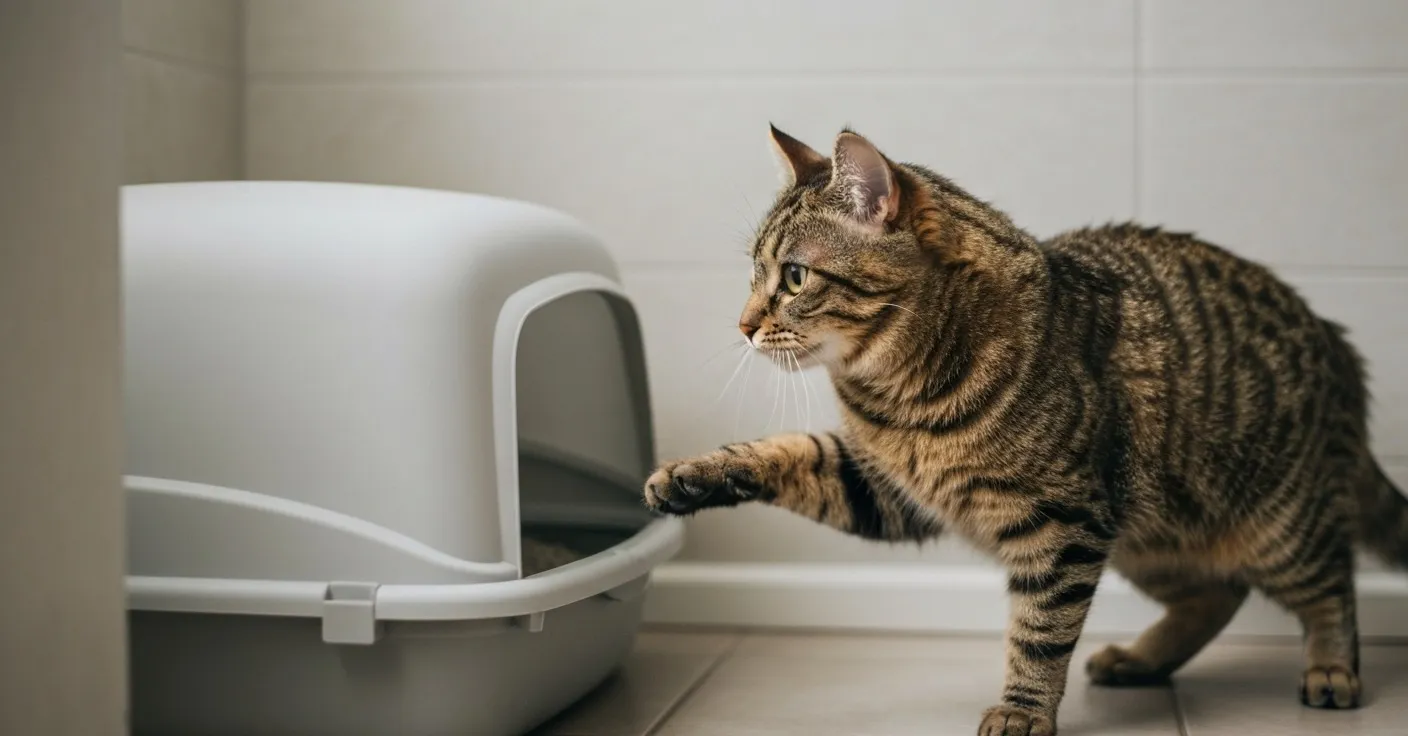
A few winters ago a client called me about her ten-year-old grey tabby, Pewter, who had started peeing on the bathmat. He had been a reliable box user for a decade. Now there were two small damp spots a day on the mat outside the shower, and she had spent a weekend reading forums that told her he was stressed, jealous of the new baby, or angry about the couch being moved. She had bought a pheromone diffuser, swapped the litter twice, and added a second box. None of it changed anything.
When Pewter came in, his bladder was the size of a small plum on palpation and he flinched when I pressed it. He had feline idiopathic cystitis. The bathmat had nothing to do with the baby. He was associating the litter box with the burning sensation he felt every time he tried to use it, and the soft absorbent mat was the closest alternative he could find.
This is the part of feline house-soiling that the internet gets wrong most often. Stress and litter preference are real factors, and we will get to both. But by the time a cat is missing the box, roughly one in three cases turns out to have a medical driver underneath (Defauw et al., 2011). The order in which you work through the possibilities matters. Behavior changes get solved when you start from the body and move outward, not the other way around.
The five-cause hierarchy, in triage order
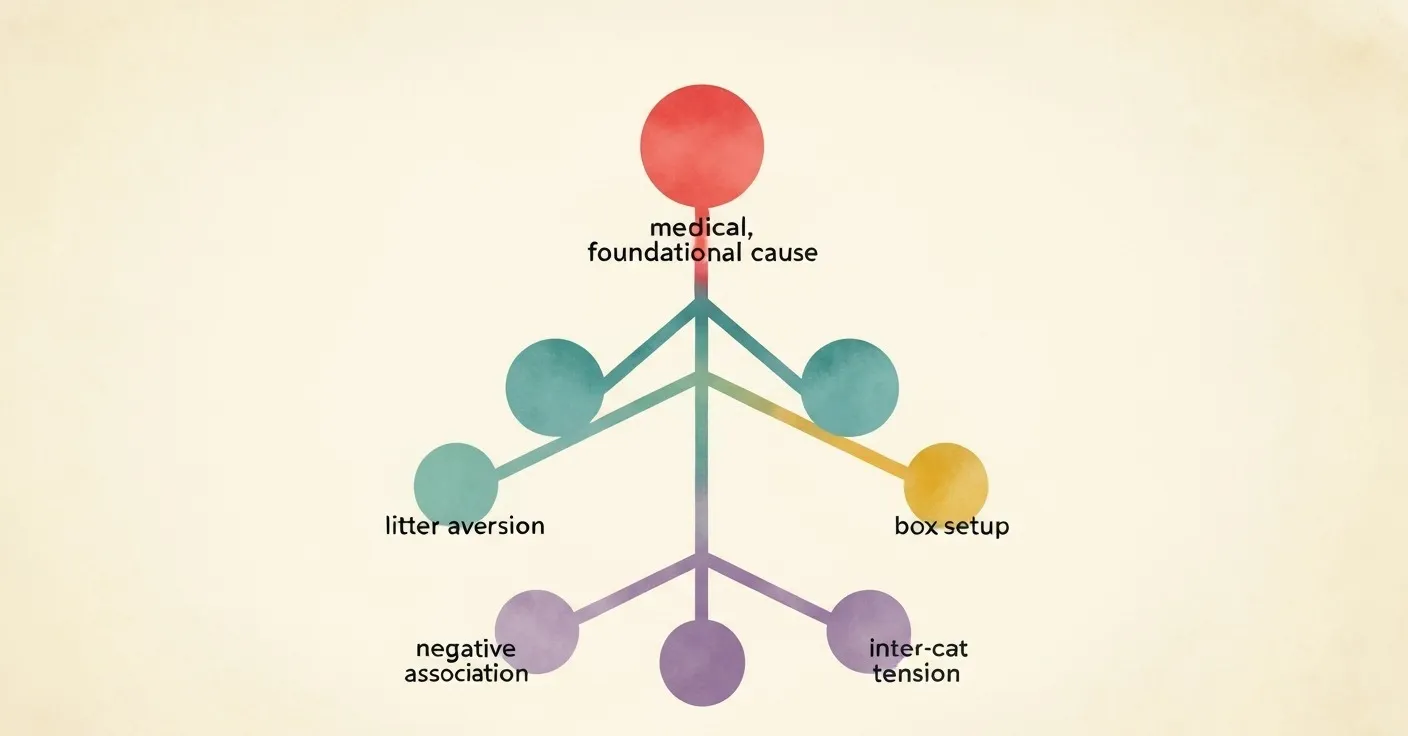
Working through litter-box avoidance is a differential diagnosis problem. You are not looking for the one true cause; you are ruling things in and out in the order most likely to matter. The hierarchy I use in clinic, and the one that holds up well against the peer-reviewed behavior literature, goes like this:
- Medical — urinary tract disease, metabolic disease, joint pain
- Litter aversion — substrate, scent, depth
- Box setup — number, size, location, hood, depth of fill
- Negative association — past pain or fear linked to the box itself
- Inter-cat tension — resource guarding in multi-cat households
The reason this order matters: medical causes can be life-threatening within hours in a male cat, and they almost always require a vet’s hands on the bladder. Everything below the first tier can wait a day or two. The first tier sometimes cannot wait at all.
Cause 1: Medical conditions
Several common medical issues can present first, and sometimes only, as a change in litter-box behavior. The cat is not being defiant. The cat is sick and trying to communicate it through the only channel that gets your attention.
Feline lower urinary tract disease (FLUTD) is the umbrella term that covers most of these cases. It includes feline idiopathic cystitis (FIC), bladder stones, urethral plugs, and bacterial urinary tract infections. FIC alone accounts for somewhere between 55 and 70 percent of FLUTD cases in cats under ten years old (Forrester, 2018). Despite the name, FIC is not random — it is a stress-responsive inflammatory condition of the bladder lining, closely linked to environmental and social pressure (Buffington, 2011; Westropp & Buffington, 2003).
True bacterial UTIs are far less common in cats than most owners assume, particularly in cats under seven. The classic studies put bacterial culture-positive rates at under 2 percent of young cats presenting with lower urinary signs (Lulich et al., 1996). The likelihood climbs in senior cats and in cats with concurrent kidney disease or diabetes. The point: assuming a cat with house-soiling has a “UTI” and dosing leftover antibiotics is both wrong and harmful most of the time.
Diabetes mellitus causes polyuria, meaning the cat is producing far more urine than usual. A previously fine box can suddenly feel inadequate to a diabetic cat because there is genuinely too much volume to hold. The same cat will often be drinking noticeably more water.
Chronic kidney disease (CKD) is common in cats over ten and similarly produces dilute, high-volume urine. The cat may make it to the box most times and miss occasionally, simply because the urge comes more often.
Arthritis is the medical cause that gets missed most often, and it changes the picture in a quiet way. A senior cat with degenerative joint disease may stop being able to step over the high lip of a covered box, or may find the climbing posture in a deep tray painful. The cat is not avoiding the litter; the cat is avoiding the box.
What ties this tier together is that the behavior change is downstream of physical discomfort. Cleaning the box harder, switching litter brands, or adding a pheromone plug-in will not solve any of these. A vet visit with a urinalysis, a full bloodwork panel for older cats, and a careful orthopedic exam usually pins down what is happening within a single appointment.
Cause 2: Litter aversion
Once the medical tier is reasonably clear, the next question is whether the cat dislikes the litter itself. Cats have strong substrate preferences, and the research is fairly consistent about what they choose when given options.
In the classic preference studies, most cats select unscented fine-grained clumping clay over crystal, pellet, or pine alternatives (Neilson, 2003; Horwitz, 2010). Texture matters more than brand. The fine sand-like grain mimics the dry soil cats evolved to use, and it sits comfortably between the toes during digging.
Scent additives are the single most common mistake owners make. Litters marketed as “fresh linen” or “spring rain” are formulated for the human nose, not the feline one. A cat’s olfactory threshold is roughly fourteen times more sensitive than ours; what reads as pleasant to us reads as overwhelming to the cat (Sung & Crowell-Davis, 2006). Cats given a choice between scented and unscented litter consistently choose unscented, often by wide margins.
Depth is the other quiet variable. Most cats prefer roughly 1.5 to 2 inches of litter — enough to dig and cover, not so much that the surface feels unstable underfoot. Owners often fill boxes higher in an attempt to manage odor or extend cleaning intervals. The cat reads the deeper layer as unstable and starts eliminating elsewhere.
If you are at the litter-aversion stage, the diagnostic test is simple. Set up a second box right next to the existing one, fill it with a different litter — unscented fine-grain clumping clay is the safest default to test against — and watch which one the cat uses for a week. Cats will tell you their preference clearly when given the side-by-side option.
Cause 3: Box setup and location
The box itself, where it sits, and how many of them exist are the variables most directly under an owner’s control, and they are the ones most often gotten wrong.
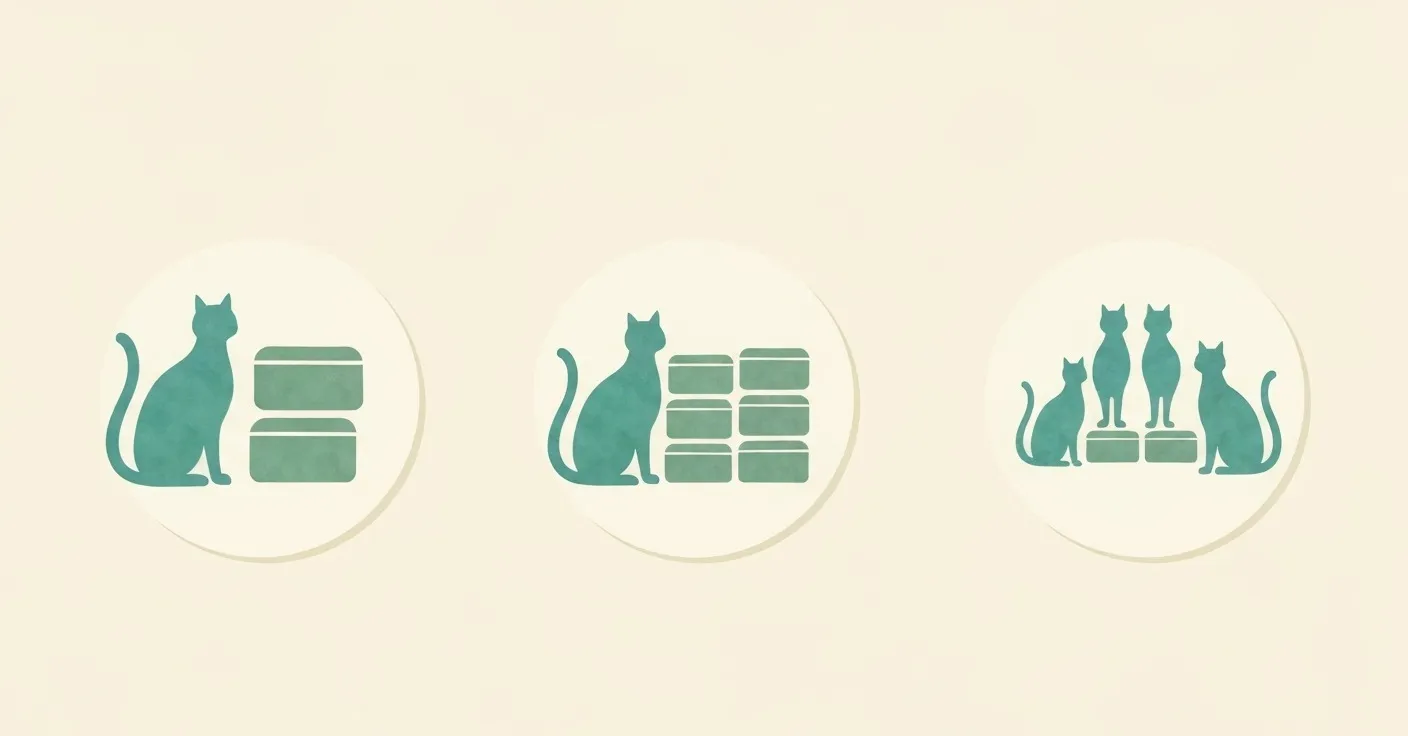
The n+1 rule is the well-established starting point: one box per cat in the household, plus one extra. A single cat needs two boxes. Two cats need three. The rule emerged from observational studies of multi-cat households and consistently correlates with lower house-soiling rates (Cameron et al., 2004; Heath, 2018). The reasoning is partly hygienic — cats often urinate in one location and defecate in another — and partly social, since cats in shared homes do better with multiple options that reduce the need to negotiate access.
Box size is the next missed detail. The general guideline is that a box should be roughly 1.5 times the length of the cat from nose to base of tail. Most commercial litter boxes are sized for kittens or small adults and end up cramped for the median ten-pound house cat. Storage totes from a hardware store, with a low-cut entry, make better large-cat boxes than most purpose-built products.
Covered vs. uncovered is more nuanced than the internet often presents it. Hooded boxes can trap odor inside the box, where the cat actually has to spend time, even when the room outside smells fine to the owner. They can also feel like an ambush risk for a cat in a multi-pet household, since the cat cannot see who is approaching while inside. Many cats use hooded boxes without complaint; many others quietly prefer open trays once both are offered.
Location is where well-meaning setups break down. Cats prefer quiet, low-traffic spots with at least two escape routes visible from the box. Common bad choices include: next to a noisy washing machine, in a tight closet with no second exit, in a basement the cat has to navigate stairs to reach (especially relevant for older cats), or directly adjacent to food and water. The food-and-water proximity in particular runs against feline instinct — cats evolved not to eliminate near their food source, and a box placed three feet from the dinner bowl is a setup the cat will often quietly reject.
Cause 4: Negative association
This is the cause that bridges medical and behavioral, and the one Pewter from my opening anecdote fits squarely into.
A cat who has experienced pain during urination — from cystitis, a urethral plug that passed on its own, a bout of bladder stones — often forms a learned aversion to the location where the pain occurred. The bladder heals. The mental link does not. Months later, the same cat may continue avoiding the box not because anything is currently wrong, but because the box itself has become associated with discomfort (Westropp et al., 2007).
The same kind of association can form from non-medical events. A cat startled by a loud noise — a vacuum running nearby, a dropped pot lid, a dog barging into the room — while inside the box can flag the location as unsafe. Cats whose boxes were recently cleaned with strongly scented disinfectants sometimes refuse to return even after the smell fades. Bleach residue, citrus cleaners, and pine-based products are particularly prone to creating this kind of avoidance.
Solving negative association generally requires moving or replacing the box, not just cleaning it. A new box in a new location, ideally a quieter one, lets the cat make a fresh association without the prior baggage. Keep the original box in place as well for a few weeks. The cat usually drifts toward the new option on their own.
Cause 5: Inter-cat tension
In multi-cat households, the litter box is a resource, and like all resources it can become a flashpoint for social pressure. This rarely looks like open fighting. It looks like one cat sitting calmly in a doorway while another cat decides not to walk past them to reach the box.
Resource guarding in cats is subtle. A dominant cat may camp on a couch arm with a clear sightline to the only box on that floor of the house, and a more submissive cat simply stops using it. Owners often miss this entirely because there are no obvious fights — just one cat who has quietly started peeing on the entryway rug.
Carlstead and colleagues’ early stress work showed how strongly social density and resource access drive urinary signs in group-housed cats, and the pattern holds in home environments (Carlstead et al., 1993). Multi-cat households with a single box on a single floor of a multi-story home are running the highest-risk setup. Spreading boxes across floors, around corners, and out of direct sightline from each other gives the more cautious cats safe access without having to negotiate.
If you suspect inter-cat tension, the change to make is geographic rather than chemical. More boxes, more locations, fewer chokepoints. Pheromone products can play a supporting role but are not a substitute for resource redistribution.
What to do when the behavior starts
The risk-graded response below is the framework I give clients on the phone. The first tier is always medical screening for any cat, because skipping it is how the genuinely dangerous cases get missed.
Watch and adjust at home if: the cat has had a single isolated accident, is otherwise eating, drinking, and behaving normally, and you can identify a plausible non-medical trigger (a recently scented litter change, a move, a houseguest, a new pet). Scoop daily, swap to unscented fine-grain clumping clay if you are currently using anything else, add a second box in a different location, and watch closely for 48 to 72 hours. If accidents continue beyond that window, or any urinary signs appear, move to the next tier. A daily nutritional baseline that helps maintain healthy digestive function — see our explainer on signs of good gut health in cats — supports overall wellness during this kind of household reset. Petterm Probiotic Hairball Control Powder is a daily option many owners use as part of broader feline wellness routines, alongside fresh water access and a stable feeding schedule.
Call your vet within 24 to 48 hours if: the cat is urinating outside the box more than once, is producing small frequent urinations, is going in and out of the box repeatedly without much output, is straining visibly, or has had any house-soiling pattern persist beyond two days. Blood-tinged urine, even faintly pink, belongs in this tier. So does a cat who has started vocalizing during elimination, who has lost interest in food, or who is grooming the genital area more than usual. Senior cats with new house-soiling should be seen within 48 hours regardless of other signs, because the differential at that age includes CKD, diabetes, hyperthyroidism, and arthritis — all of which benefit from earlier rather than later identification.
Seek same-day emergency care if: a male cat is straining to urinate and producing little or no output. This is the line that absolutely does not bend. Male cats have a long narrow urethra that can be obstructed by urethral plugs or small stones, and a complete obstruction is a medical emergency that progresses to kidney failure and death within 24 to 48 hours. The cat may cry while in the box, lick the genital area excessively, vomit, become lethargic, or hide. Any combination of straining and no urine output in a male cat is an emergency room visit, not a phone call to wait on. Other same-day-care signs in either sex: a hard, painful bladder you can feel through the abdomen, marked weakness, collapse, or blood in the urine accompanied by lethargy.
Frequently asked questions
My cat only pees outside the box occasionally — is that still a problem?
Yes, intermittent accidents in a previously reliable cat warrant attention. The pattern that worries me clinically is not a one-time accident in an obvious context (cat was locked out of the room with the box) but recurring accidents without a clear trigger. Track location, frequency, and whether it is urine or stool — that information shapes the differential.
How do I tell urine marking from inappropriate elimination?
Urine marking is usually small volumes sprayed on vertical surfaces with the tail upright and quivering, and the cat almost always continues using the litter box for normal urination alongside it. Inappropriate elimination is full-volume urine deposited on horizontal surfaces, often soft absorbent ones like rugs, beds, and laundry. The medical workup overlaps but the behavioral picture is different.
Can probiotics help with litter-box issues?
Probiotics support healthy gut function and may contribute to overall feline wellness, but they are not a treatment for litter-box avoidance. The use case is supporting daily digestive baseline in cats who are otherwise healthy, which can help maintain comfort and routine. For the science on this, see our breakdown of how probiotics work in cats.
My cat started peeing on the bed after I got a new puppy. Is it spite?
Cats do not pee out of spite — the neurology does not work that way. What you are likely seeing is either stress-driven FIC triggered by the household change, or a deliberate choice of an elevated, soft, owner-scented surface that feels safer than the floor-level box near the new pet. Both call for a vet visit first and then a setup review.
Does covered or uncovered matter that much?
It matters for some cats and not others. The honest answer is to offer both, side by side, and watch which one your cat uses. Most cats with no strong opinion will use either; the cats who care will tell you in a week.
How fast does urethral obstruction become an emergency in a male cat?
Faster than most owners realize. The bladder can rupture or the kidneys can shut down within 24 to 48 hours of complete obstruction. If you see your male cat straining in the box repeatedly without producing urine, do not wait until morning. Drive to an emergency clinic.
Will my cat ever go back to the box after a long period of avoidance?
Most cats do, with the right setup adjustments and resolution of any medical driver. The longer the avoidance has been going on, the more important it becomes to create a genuinely fresh start — new box, new location, possibly new litter — rather than trying to rehabilitate the original box.
When to contact your veterinarian
Watch at home: A single isolated accident in an otherwise healthy cat with a plausible non-medical trigger, where you can adjust the setup (clean box, unscented fine-grain litter, add a box, check the location) and monitor for 48 to 72 hours. Daily gentle observation of urine and stool output, appetite, water intake, and grooming behavior. Consistent feeding routine and nutritional baseline that supports overall wellness.
Call your vet within 24 to 48 hours: House-soiling that has continued past two days, any straining, frequent small urinations, blood-tinged urine, vocalizing in the box, excessive genital grooming, reduced appetite, or new house-soiling in any senior cat regardless of other signs. The standard workup at this visit is a urinalysis with specific gravity, urine sediment, and often a culture, plus age-appropriate bloodwork. In senior cats, expect a discussion of CKD, diabetes, thyroid, and arthritis as part of the differential.
Seek same-day or emergency care: A male cat straining without producing urine — this is the non-negotiable one, full stop, drive to a clinic. A painful or distended bladder palpable through the abdomen. Marked lethargy or weakness paired with urinary signs. Repeated vomiting alongside straining. Collapse. Blood in the urine combined with weakness or hiding behavior. These pictures can progress to kidney failure, electrolyte derangement, and death within hours.
References
-
Buffington, C.A.T. (2011). “Idiopathic cystitis in domestic cats — beyond the lower urinary tract.” Journal of Veterinary Internal Medicine, 25(4), 784–796.
-
Westropp, J.L. & Buffington, C.A.T. (2003). “Feline idiopathic cystitis: current understanding of pathophysiology and management.” Veterinary Clinics of North America: Small Animal Practice, 33(4), 1043–1055.
-
Defauw, P.A.M., et al. (2011). “Risk factors and clinical presentation of cats with feline idiopathic cystitis.” Journal of Feline Medicine and Surgery, 13(12), 967–975.
-
Forrester, S.D. (2018). “Lower urinary tract diseases in cats.” In Ettinger, S.J. et al. (eds.), Textbook of Veterinary Internal Medicine, 8th ed., 1995–2005.
-
Lulich, J.P., et al. (1996). “Feline idiopathic lower urinary tract disease.” Veterinary Clinics of North America: Small Animal Practice, 26(3), 539–571.
-
Westropp, J.L., et al. (2007). “Evaluation of the effects of stress in cats with idiopathic cystitis.” American Journal of Veterinary Research, 67(4), 731–736.
-
Cameron, M.E., et al. (2004). “A study of environmental and behavioural factors that may be associated with feline idiopathic cystitis.” Journal of Small Animal Practice, 45(3), 144–147.
-
Carlstead, K., Brown, J.L., & Strawn, W. (1993). “Behavioral and physiological correlates of stress in laboratory cats.” Applied Animal Behaviour Science, 38(2), 143–158.
-
Heath, S. (2018). “Feline house-soiling: an update.” In Practice, 40(3), 110–120.
-
Horwitz, D.F. (2010). “Behavioral and environmental factors associated with elimination behavior problems in cats: a retrospective study.” Applied Animal Behaviour Science, 52(1–2), 129–137.
-
Neilson, J.C. (2003). “Feline house-soiling: elimination and marking behaviors.” Clinical Techniques in Small Animal Practice, 19(4), 216–224.
-
Sung, W. & Crowell-Davis, S.L. (2006). “Elimination behavior patterns of domestic cats with and without elimination behavior problems.” American Journal of Veterinary Research, 67(9), 1500–1504.
Researched and reviewed by the Petterm Editorial Team · Last reviewed May 2026
This article is for educational purposes and is not veterinary medical advice. Petterm products are not intended to diagnose, treat, cure, or prevent any disease. Results may vary. Always consult your veterinarian before introducing a new supplement, especially if your cat has an existing condition, takes medication, is pregnant, or is under 12 weeks old.